Uranus and Neptune have magnetic fields that look more like tangled wiring than the tidy pattern we see on Earth. A new study suggests the cause sits deep inside the planets, where extreme pressure changes how their interiors conduct electricity.
Two lopsided fields
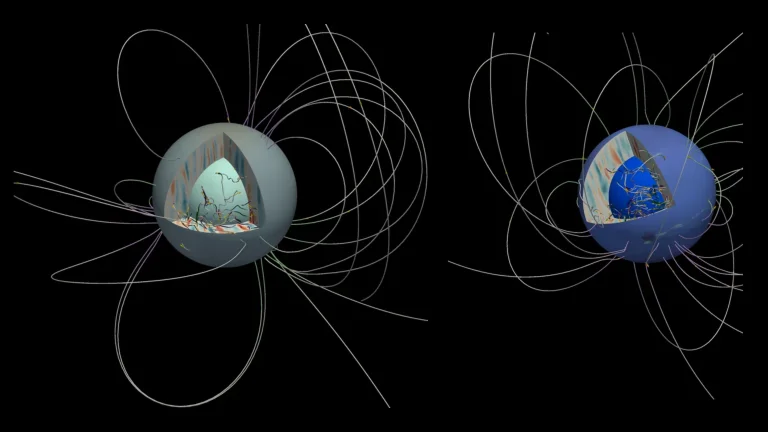
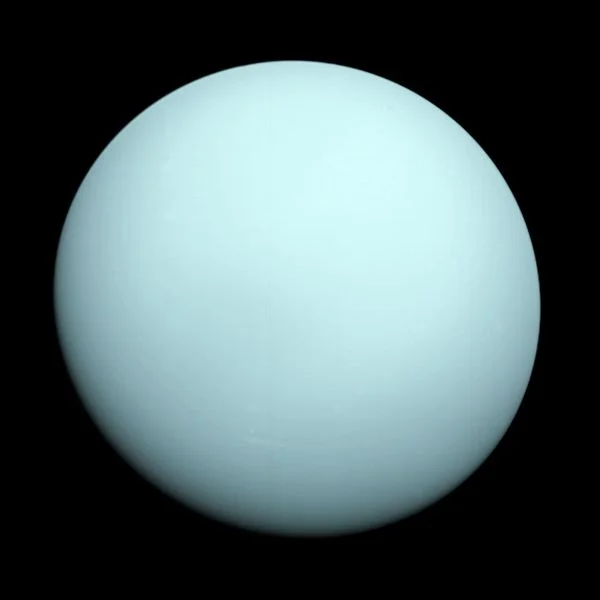
Only one spacecraft has ever visited either ice giant. Voyager 2 flew past Uranus in January 1986 and Neptune in August 1989, and its measurements showed fields that are badly out of line. Uranus's field is tilted 59 degrees from the planet's rotation axis, and it isn't centered on the core. It sits roughly two-thirds of the way down toward the surface. Neptune's field is tilted 47 degrees and sits halfway between its core and its cloud tops.
Earth's field is tilted only 11 degrees from its rotation and stays comparatively stable. The ice giants aren't just a bit off. They're playing by different rules.
Why the usual explanation falls short
Uranus's whole body is tilted 97 degrees, so it effectively rolls around the sun. The popular story is that a collision with a long-lost, Earth-sized planet knocked it onto its side billions of years ago, and that impact might have scrambled the field as well. Here's the problem: Neptune's field is skewed too, and nobody has a convincing case for a similar collision there. That points to something built into how these planets work.
A dynamo under pressure
Planetary magnetic fields usually come from a dynamo, where an electrically conducting fluid churns and convects inside a rotating body. On Earth, that fluid is molten iron in the outer core, and it produces a clean dipole with distinct north and south poles, much like a bar magnet.
Uranus and Neptune are a different story. Their interiors are loaded with volatiles, including ammonia, hydrogen, helium, methane and water, wrapped around what's probably a rocky core. They're also far heavier than Earth, at about 14.5 and 17 times our mass. That weight squeezes the interior hard.
"Deep inside Uranus and Neptune, pressures and temperatures become extremely high," said Chi Yan of the University of Texas at Austin, who led the new work, in a statement. "Under those conditions, which can cause water molecules to break apart into ions, the material may become increasingly electrically conductive with depth."
Simulations that reproduce the strange fields
Feeding that rising conductivity and each planet's composition into computer simulations reproduced the lopsided fields of both worlds. The magnetic structure evolves alongside the convective fluid motion and the internal temperature, so the field's shape isn't fixed. That's the detail I find most telling.
The models also suggest the fields are still changing. In some stretches, the tilt can swing by tens of degrees within a few decades. In others, it barely moves. Yan put the contrast plainly: "Earth's magnetic tilt drifts by only a degree or so over 50 years. Our models show the ice giants can behave very differently. In some stretches, the tilt swings by tens of degrees within decades. In others, it shifts only slightly over the same span."
Waiting on fresh data
Voyager 2 remains the only close-range dataset, and it's now about 40 years old. NASA has prioritized a new mission to return to Uranus in the early 2040s. China's Tianwen-4, launching toward Jupiter in 2029, will deliver a small probe that continues on to Uranus via a gravitational slingshot.
Until then, researchers are finding workarounds. Tom Stallard of Northumbria University, a co-author on the paper, is leading James Webb Space Telescope observations of faint infrared auroral lights on both planets. Auroras form when charged particles from the solar wind hit a planet's magnetic field and funnel into the atmosphere above the magnetic poles, so their shape reflects the field's configuration. Neptune's quadrupolar component muddies its poles, but the auroral patterns still carry useful information.
"We are busy working on what's contained within these observations, but the shape and structure of the aurora, as well as other weird patterns in the ionosphere [upper atmosphere], promise to provide us with a way of understanding how the magnetic fields have changed, [which is] an important stepping stone," said Stallard.
The plan is to combine the JWST aurora data, Voyager 2's field measurements and the simulations to estimate how the fields look today and compare them with the 1980s. That would offer a real test of the new model. Confirmation, though, will have to wait for a spacecraft in the ice giants' neighborhood.
The findings were published 3 November in Communications Physics.