For seven years, NASA's TESS telescope tracked a hot Jupiter that kept arriving at the wrong time. Then, in March 2026, the planet stopped showing up at all. Astronomers now think TOI-2535 b never went anywhere. Something else is pushing it around, and that push tilted the planet's orbit until its transits no longer lined up with Earth.
TOI-2535 b sits about 1,000 light-years away and completes an orbit of its star every 8.25 Earth days. That's roughly ten times faster than Mercury circles the sun, which puts this scorching world firmly in the hot Jupiter category. TESS observed it routinely from April 2019 through March 2026, and the early data hinted at trouble. The planet often showed up six hours early or six hours late compared with predictions. For a supposedly regular orbit, that's a red flag.
A hidden neighbor is doing the pulling
The team used TESS data to show that TOI-2535 b is being tugged by an unseen neighbor, and it's tugging back. Both worlds in the system wobble as a result. At some point the wobble swung TOI-2535 b out of alignment with its star, and the dips in starlight that TESS had been catching simply stopped.
Samuel Yee of the University of California, Los Angeles, put the idea plainly. "We think of the universe as resembling clockwork, where everything is regular, but that's not true. If there are multiple planets in a system, they can affect each other's orbits. We know of a few systems that are like this," Yee said in a statement. "This is the most extreme example we've seen because the two planets are interacting so strongly. The planet's orbit is tilting so quickly that its transit disappeared while we were watching."
Don't expect TOI-2535 b to reappear soon. It isn't predicted to transit its star for at least 30 years. The hidden companion, though, could cross the star's face well before that, and that would give astronomers a second window into the system.
Hot Jupiters were supposed to form differently
The formation question is where this gets interesting. Current models suggest hot Jupiters start far from their stars, where ice is plentiful, and then migrate inward. Ice can't survive that close to a star, so these planets had to travel.
There are two proposed routes. In the first, a violent event such as a near-collision with another planetary body knocks the planet into a stretched, elliptical orbit. Gravitational interactions with the star then drag it inward. In the second, gentler route, the planet drifts inward with its siblings while still embedded in the protoplanetary disk, the flattened cloud of gas and dust that surrounds a young star.
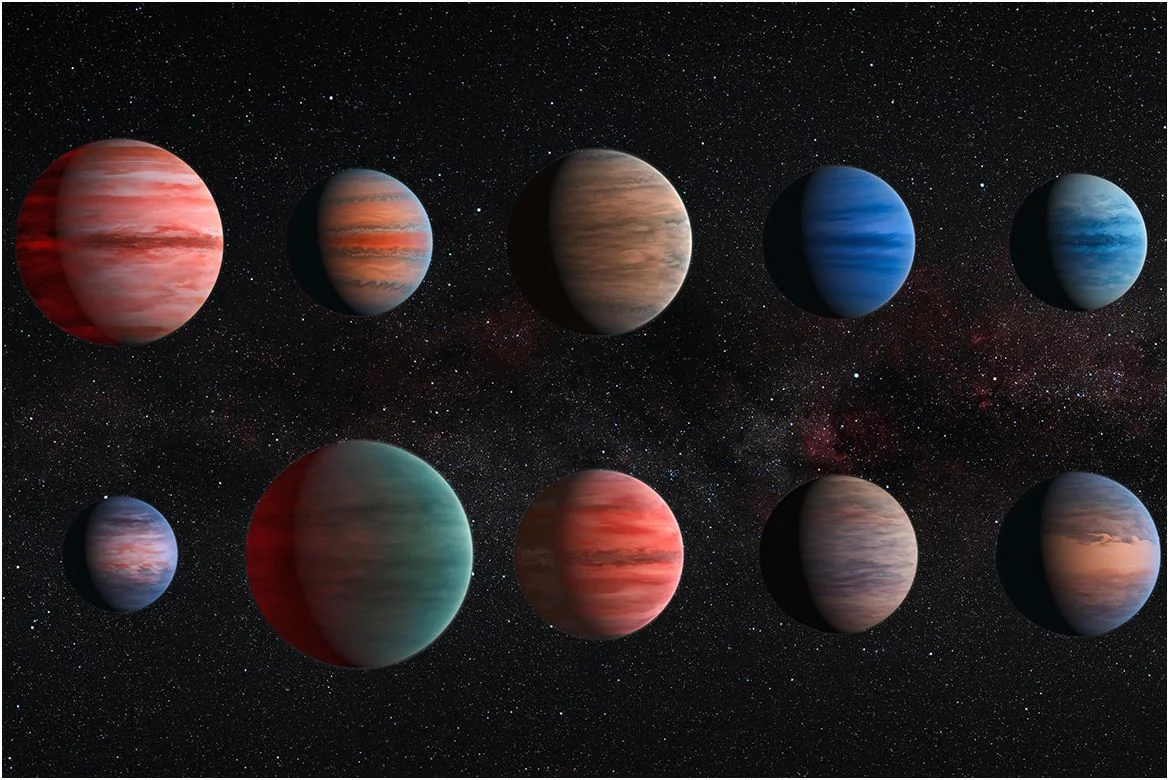
If the gentle route is the main pathway, the resulting systems should be very flat, with little tilt between the planets' orbits. TOI-2535 b breaks that expectation. Its tilt shows that a flat system can be knocked askew by a more inclined companion, and that happening later in a system's life doesn't rule out slow inward migration.
"Because TOI-2535 b has a close neighbor, it probably migrated by slowly spiraling in instead of getting flung in," Yee said. "We may be seeing a formation channel that doesn't happen very often but is very interesting."
My read: this is a reminder that a hot Jupiter's history can't be read from its current position alone. If companions can tilt a quiet system after the fact, some of the single-planet models we lean on could be missing a chapter. The next question is how common this kind of wobble is across other systems, and whether TESS's long baseline can catch more of them before they vanish from view.
The team's research was published Monday (Nov. 9) in the Astrophysical Journal Letters.