A planet recovered from the glare
The James Webb Space Telescope had already observed the star system 51 Eridani. The planet astronomers were looking for, however, remained buried in the star’s glare. A new image processing method has now recovered it from those JWST observations, showing how much direct imaging can depend on the tools used to interpret telescope data. The telescope had collected the light; the challenge was separating a faint companion from the much brighter star beside it.
51 Eridani b is a gas giant roughly 11 times the mass of Jupiter, orbiting a star about 97 light-years away. Ground-based telescopes discovered it in 2015, but JWST images of the system didn’t reveal the planet. That gap matters: an observation can contain useful evidence that standard processing fails to expose. The challenge wasn’t the telescope’s reach. Even bright exoplanets can appear 100,000 times fainter than their host stars, making a small amount of leftover starlight enough to overwhelm the signal astronomers want to study.
A coronagraph blocks much of a star’s light, but some glare still reaches the detector. Astronomers have traditionally reduced the remaining glare by taking an image of a different star and subtracting it from the observation. The approach gives researchers a reference for the unwanted light, though differences between the two observations can leave residual patterns behind. Jason Wang of Northwestern University described the method in a statement: “For the past 20 years, astronomers have tackled this problem by observing a different star and using its image as a reference.”
Modeling a telescope’s tiny movements
Reference images can’t fully account for the small shifts in a telescope’s optics. JWST’s NIRCam instrument, for example, relies on cryocoolers to stay cold. Their motors can produce slight vibrations, scattering starlight in ways that leave enough residual glare to hide a nearby planet. The effect is a reminder that high quality instruments still have physical behavior that image processing must account for.
The research team’s answer is Physics-based Learning for Imaging Planets, or FLIP. The technique builds a digital model of the telescope, simulating how light moves through its mirrors and reaches its detectors. Researchers tune the model to match millions of small imperfections in the real instrument, then use its simulated glare to remove residual starlight from the observed image. The basic idea is to estimate the interference from the system itself, rather than relying only on a separate star as a stand in.
That distinction is more significant than it looks. In direct imaging, a planet’s light and the star’s residual glare occupy the same observation, so a processing method has to distinguish between signal and instrument effects with care. A model that better represents those effects could make faint objects easier to detect, though its results still depend on how well the model matches the real telescope.
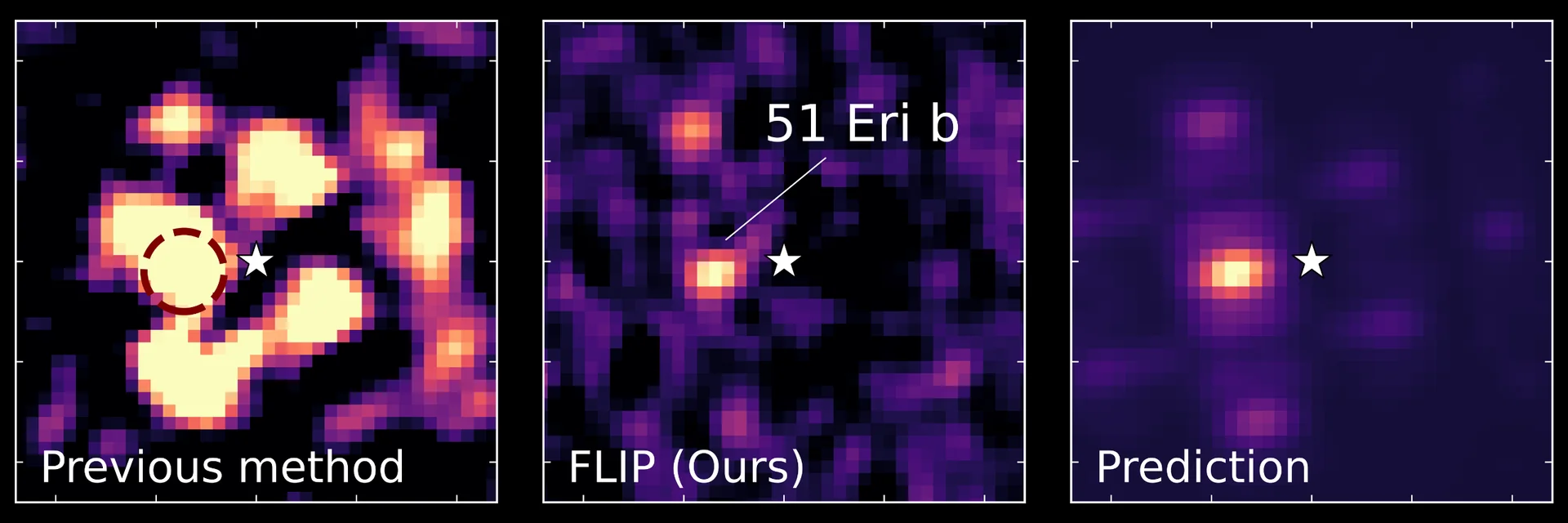
To evaluate FLIP, the team reprocessed JWST observations of two systems with known exoplanets, HIP 65426 and 51 Eridani, as well as TYC 5899, where no planets are known. The method detected faint planets between two and 15 times better than conventional image processing, and brought 51 Eridani b into view in data collected two years earlier. That comparison offers a practical demonstration: the method recovered a known planet from existing observations, rather than relying on a future telescope or a new round of data collection.
“We showed that we can actually recover a planet that people previously couldn’t see,” Wang said. “This is real data in a real scenario. It was science left on the table because we didn’t have the right tools to analyze the data in the most optimal way.” His point is about interpretation as much as instrument performance: observations can outlast the methods first used to analyze them. A reanalysis may therefore change what researchers can learn from data already in hand.
More planets may be hiding in existing data
The result suggests that archived observations could contain exoplanets that current processing methods have missed. The team hopes other astronomers will adopt FLIP to search for worlds obscured by their host stars. If you’re working in this space, the immediate question is whether the method’s gains can be reproduced across other observations and targets. The study points to a way to look; it doesn’t establish how many hidden planets are waiting in existing data.
That could also matter for NASA’s proposed Habitable Worlds Observatory, which is intended to directly image Earth-like planets orbiting distant sun-like stars. The goal makes the starlight problem especially relevant: a much fainter planet can be difficult to distinguish from the star it orbits. Better image analysis may help researchers interpret observations from future instruments, but the article’s result concerns JWST data and 51 Eridani b. Team leader Rodrigo Ferrer-Chavez of Northwestern University said, “We know of no planets around other stars that are like those in our own solar system. It’s not that they don’t exist. It’s that we cannot see them.”
Ferrer-Chavez added that better techniques can reveal new kinds of planets and help researchers understand how planetary systems form and evolve. The team’s study was published Wednesday, Nov. 4, in Nature. FLIP’s immediate contribution is concrete: it has turned a previously unseen planet into a target for further study. And this is the part most people overlook: a recovered planet is a starting point for follow-up work, not an answer to every question about its atmosphere or origin.
What the result changes
The finding makes a case for treating image processing as part of observational astronomy, not a final cosmetic step. A telescope collects light, but the method used to remove its own optical effects can influence which faint companions researchers can identify. That said, a strong result on these systems doesn’t by itself show that FLIP will work equally well on every target or dataset. The useful test will be whether other teams can apply the method and recover signals that hold up to further study.
For now, the clearest implication is modest and useful: some existing JWST observations may deserve another look. If a planet can be recovered from data that were already collected, the archive may hold more scientific value than its first analyses revealed. A second pass, with a better model of the instrument.