NASA’s Dragonfly mission will turn Titan into a destination for public names as well as planetary science. The agency is accepting submissions for a chip that will travel aboard the rotorcraft, with names due by Jan. 15, 2027. It’s a small public gesture attached to a mission with a much larger scientific ambition: carrying instruments across the surface of Saturn’s largest moon.
Dragonfly is an SUV-sized, nuclear-powered aircraft NASA plans to launch in 2028. People can submit names through the agency’s special events page. The names will be added to a chip during spacecraft assembly, placing them aboard a vehicle expected to travel far beyond Earth and spend years exploring another world.
A mobile laboratory on Titan
Dragonfly is designed to explore multiple sites across Titan rather than remain at a single landing point. NASA expects it to arrive in 2034 and operate for about 3.3 Earth years, visiting locations that include sweeping dunes and Selk, a relatively young impact crater. That itinerary makes mobility central to the mission: each stop can offer a different setting for examining Titan’s surface materials.
Each flight is expected to take place every one to two Titan days. A Titan day, known as a Tsol, lasts about 16 Earth days, so the planned rhythm is slow by terrestrial standards but suited to a remote mission operating on another world. At its stops, Dragonfly will collect surface samples and analyze them with instruments carried inside the rotorcraft. Repeated flights could let scientists compare findings from distinct environments instead of relying on measurements from one site.
Titan’s atmosphere, rivers, lakes, seasons and organic-rich terrain make it a compelling place to investigate chemistry relevant to life. Dragonfly’s goals include studying prebiotic chemistry, assessing whether Titan may once have had habitable conditions, and searching for chemical indicators associated with water or hydrocarbons. These aims concern the conditions and ingredients that might matter to life; they don’t amount to a promise that the mission will find life. That distinction matters when a mission’s public appeal can easily outrun what its instruments are designed to establish.
Building on earlier exploration
Dragonfly will be among the few aircraft to fly on another world. NASA’s Ingenuity helicopter, which accompanied the Perseverance rover to Mars in 2021, was built for five flights but completed 72. Its mission ended after its blades were damaged during a landing on Jan. 18, 2024. That record gives engineers and scientists experience with powered flight away from Earth, though Dragonfly’s destination and mission design are distinct.
NASA is also planning SkyFall, a Mars mission that would use three helicopters and could launch as soon as late 2028. The comparison underscores the growing role of aircraft in planetary exploration: a flying vehicle can reach separated locations that a rover would approach more slowly. But flight alone doesn’t guarantee useful science. The value depends on whether the craft can navigate, land, collect data and keep operating in the conditions it encounters.
Titan has already been visited by the Huygens lander, which separated from the Cassini spacecraft and reached the surface on Jan. 14, 2005. Huygens operated for several hours, measuring the atmosphere and collecting surface data. Cassini itself made more than 100 Titan flybys before its mission ended in September 2017. Together, those missions established a foundation for understanding Titan from above and at one landing site; Dragonfly is intended to extend that record through mobile surface work.
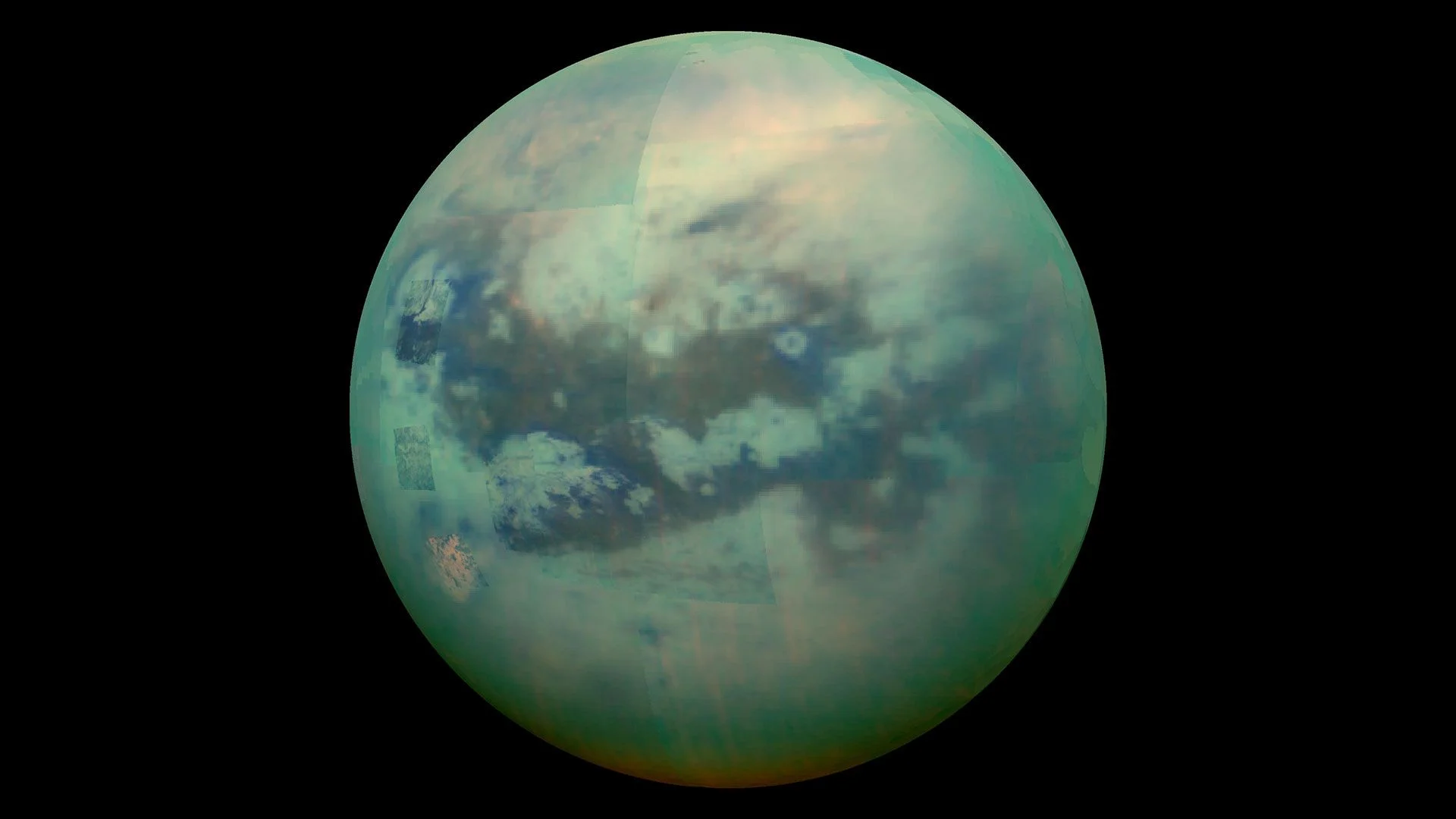
Cassini provided a long view of Titan from orbit; Dragonfly is meant to bring that investigation to the surface and across varied terrain. The mission’s reach will depend on repeated flights between sites, where its instruments can examine material in place and help clarify how far the moon’s organic chemistry has progressed. This is more significant than it looks: mobility could turn a sequence of isolated observations into a broader comparison of Titan’s environments (and this is the part most people overlook).
What the mission could clarify
Dragonfly’s central scientific opportunity is comparison. If it can visit multiple kinds of terrain and return measurements from each, researchers can ask how Titan’s surface chemistry varies from place to place and how local conditions may shape the materials found there. The mission’s planned visits to dunes and a crater give that approach a concrete focus, while its instruments will determine what can actually be learned at each stop.
There are limits to what the public can infer before the mission flies. A long itinerary and an ambitious science plan describe intent, not guaranteed discoveries; the spacecraft must first reach Titan and carry out its work across a distant, unfamiliar environment. If you're working in this space, the practical question is how well the flight plan connects instrument measurements to the mission’s questions about prebiotic chemistry and past habitability. The names chip adds a human touch. The science will have to earn the attention that comes with it.