A point of light that challenged an old idea
A bright point of light appeared in Cassiopeia on Nov. 6, 1572, challenging the idea that the stars never changed. German astronomer Wolfgang Schulër is thought to have spotted it first with the naked eye, though the source describes this as an attribution rather than a settled record of who saw it first. It shone about as brightly as Venus and was visible even in daylight. That combination made the object difficult to treat as an ordinary, faint change in the sky.
For observers, the sight raised a basic question: was this a new object, or a familiar one that had suddenly become visible? The distinction mattered in a period when many astronomers regarded the heavens as permanent and unchanging. A brilliant light appearing among the stars was therefore more than a spectacle. It put an established picture of the cosmos under pressure.
The object became known as Tycho’s Star, after Danish astronomer Tycho Brahe, whose careful observations and book De Stella Nova (“On the New Star”) made the event famous. The phrase “new star” described what observers could see, not what had physically happened. The class of stellar explosions now called supernovas had not yet been identified, so the name captured the appearance while leaving its cause unresolved.
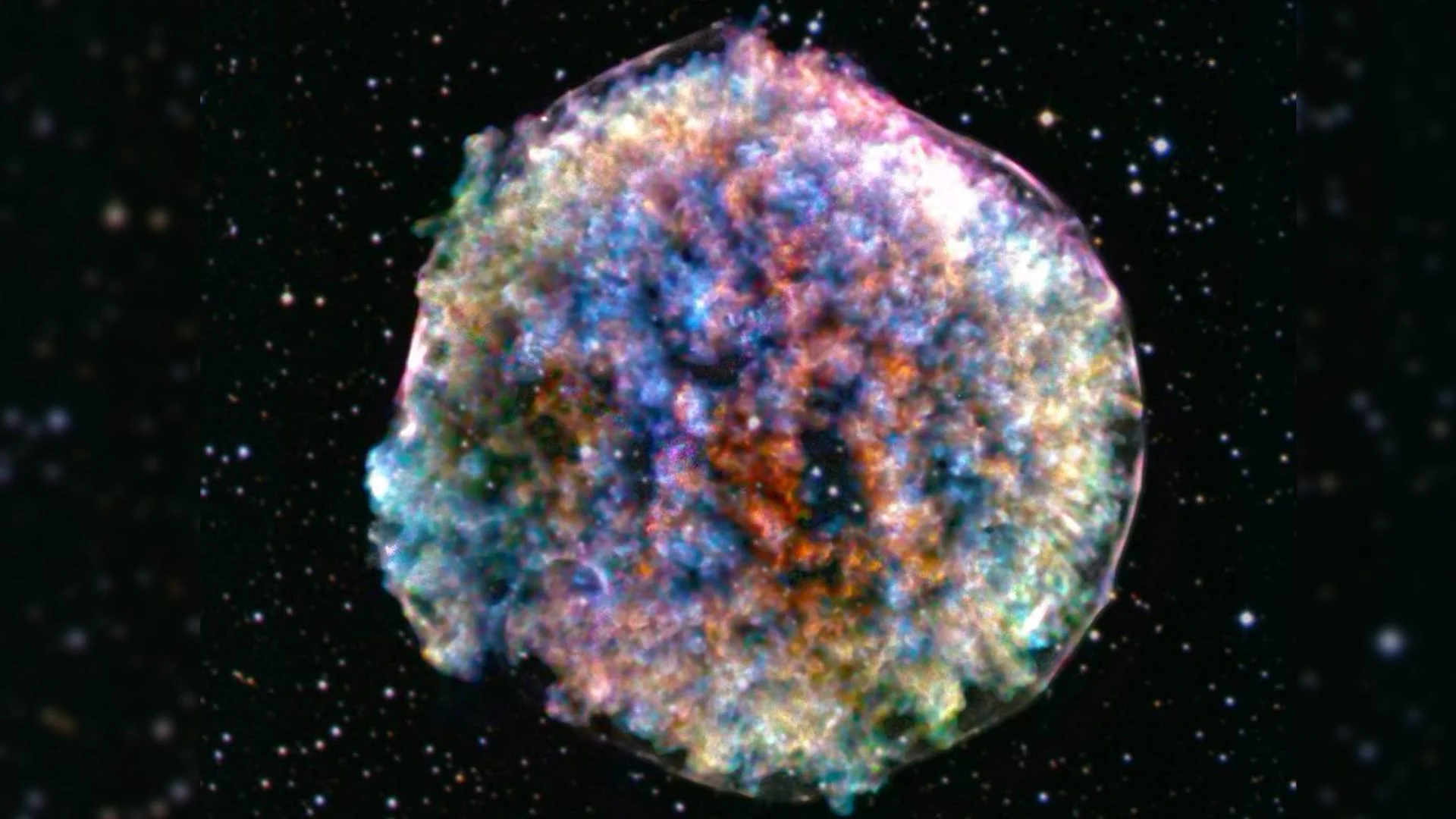
From “new star” to Type Ia supernova
Known today as SN 1572, the event is classified as a Type Ia supernova. It began in a binary star system, where a white dwarf draws material from its companion and eventually explodes. In that kind of system, the companion star supplies material to the white dwarf; the resulting explosion is powerful enough to transform the system into a remnant that can still be studied long after the original flash has faded.
The explosion happened thousands of years before its light reached Earth, roughly 13,000 light-years away. That delay is a reminder that astronomy observes events through light that has traveled across space, rather than in real time. The bright object people saw in 1572 was the arrival of that light, while the explosion itself belonged to a much earlier point in the system’s history.
Why the historical record still matters
Schulër wasn’t the only observer. Brahe’s records tracked the supernova’s changing brightness, giving later astronomers evidence to identify its light signature. The University of California, Berkeley, wrote in 2004 that the star could be seen in daylight for about two weeks and remained visible to the naked eye for 16 months. A long record of changing brightness gives researchers more to work with than a single report that a bright object appeared.
Those observations carried weight because the prevailing view held that the heavens were unchanging. Astronomer Alex Filippenko, who led a 2004 study of the supernova’s origins, called them important evidence that the sky could change. The point wasn’t simply that observers had witnessed an unusual light; they had recorded a change in the heavens over time. That’s why Brahe’s work remains central to the story, even though the event itself came to be understood through later astronomy.
This is more significant than it looks: the episode shows how careful observation can challenge a broad assumption before anyone has a complete explanation for what they’re seeing. The observations couldn’t identify the explosion’s physical mechanism on their own. They could establish that the sky wasn’t static.
A different kind of stellar outburst
Astronomers are also watching T Corona Borealis, also known as the Blaze Star. It’s expected to erupt as a nova, a smaller outburst that may leave the star intact. That difference matters: a nova can brighten dramatically without destroying the star system in the way a supernova does. The shared word “nova” can obscure how different these events are in scale and outcome.
T Corona Borealis is one of 11 known stars with recurring nova explosions, separated by roughly a century. If you're following the story, the key point is that a recurring nova isn’t a replay of SN 1572; it’s a different process, with a different likely aftermath. A dramatic increase in brightness alone doesn’t tell you which kind of stellar event is underway. And this is the part most people overlook: the historical name “new star” describes an observer’s first impression, while modern classifications distinguish the underlying behavior.
Tycho’s Star left a record that connects naked-eye astronomy with the study of stellar remnants. The light faded, but the question it raised did not. Still, the evidence has limits: a historical brightness record is not the same thing as a modern measurement of the explosion’s physics. A useful case study.
What the event means for astronomy
SN 1572 offers two kinds of evidence at once: a record of how the event looked from Earth and a remnant that can be examined with modern instruments. Those perspectives answer different questions. Historical observations help establish when the light appeared and how its brightness changed; later study can classify the event and investigate what remains.
That’s a durable lesson for astronomy. A striking observation can unsettle an accepted idea, but a fuller explanation often depends on records collected over time and evidence gathered with later tools. If you're working in this space, the Tycho story is a reminder to preserve the observation as carefully as the interpretation. The first account may be incomplete, yet still become indispensable.
Explore more space history in the On This Day In Space story archive and the On This Day In Space video collection.