The strongest evidence yet for how a stellar merger unfolds came from years of watching one star brighten before it erupted. In the Andromeda galaxy, a red giant nicknamed Big Bao swallowed its smaller companion, Little Bao, and the collision produced a luminous red nova designated AT2025abao. The value of the observation lies in that long lead-up: astronomers could compare the system’s behavior before the outburst with the aftermath, rather than reconstructing the entire event from a brief flash.
Observations from ground and space telescopes let astronomers trace the event from its slow buildup to its October 2025 flare. The campaign included NASA’s NEOWISE and SPHEREx missions, the James Webb Space Telescope (JWST), and the W. M. Keck Observatory in Hawaii. At Caltech’s Palomar Observatory, the Zwicky Transient Facility (ZTF) and the Wide-field INfrared Transient ExploreR (WINTER) recorded the eruption. Each instrument contributed a different view of the same changing system, including light at wavelengths that can reveal material otherwise obscured by dust.
That coordination matters because a stellar merger doesn’t announce itself in a single clean signal. A gradual change can look unremarkable until later observations show that it was part of a larger sequence. Here, years of monitoring gave the team a way to connect the star’s changing brightness, its dusty surroundings, and the eventual flare.
“The excitement was real,” said team member Viraj Karambelkar of Columbia University. “We couldn't quite believe our luck. With detailed observations for several years before the merger, for the first time, we now have an unprecedented glimpse of the conditions that lead to such cosmic events.”
Two years of brightening before the flare
The team first noticed an unexpected bright flash in Andromeda, then found that the star system at its center had been steadily brightening for about two years. The object, identified as WNTR23bzdiq / WTP19aalzlk, had remained stable for the previous 30 years before its gradual change began in 2019. That earlier quiet period gives the brightening a useful baseline: the system wasn’t simply showing a persistent trend that had gone unnoticed.
Big Bao is a red giant with about seven times the sun’s mass. As it exhausted hydrogen in its core, it swelled to hundreds of times the sun’s size. The team’s model suggests the expansion engulfed Little Bao, which had about 70% of the sun’s mass. The smaller star spiraled into Big Bao’s core in fewer than 10 orbits. The model offers a physical explanation for the changing light: the companion’s inward plunge and the giant’s expansion set up a collision capable of ejecting material.
“A couple of years back, we discovered a star that was gradually brightening,” Karambelkar said. “We took a closer look to discover a red giant, or a star that has started to expand toward the end of its life, just like our sun will one day.” He said the steady brightening was unusual, but astronomers didn’t expect an explosion: stars like these typically remain stable for thousands of years. That gap between an unexpected warning sign and a dramatic eruption is part of what makes the record valuable. The observations captured a system changing on a timescale that’s short by comparison with the usual stability of such stars.
This is more significant than it looks: a visible change that initially seemed subtle became an early clue to a merger. Astronomers can’t assume that every brightening star is headed for an eruption, but the case shows why long-term monitoring can alter the interpretation of an event after it happens.
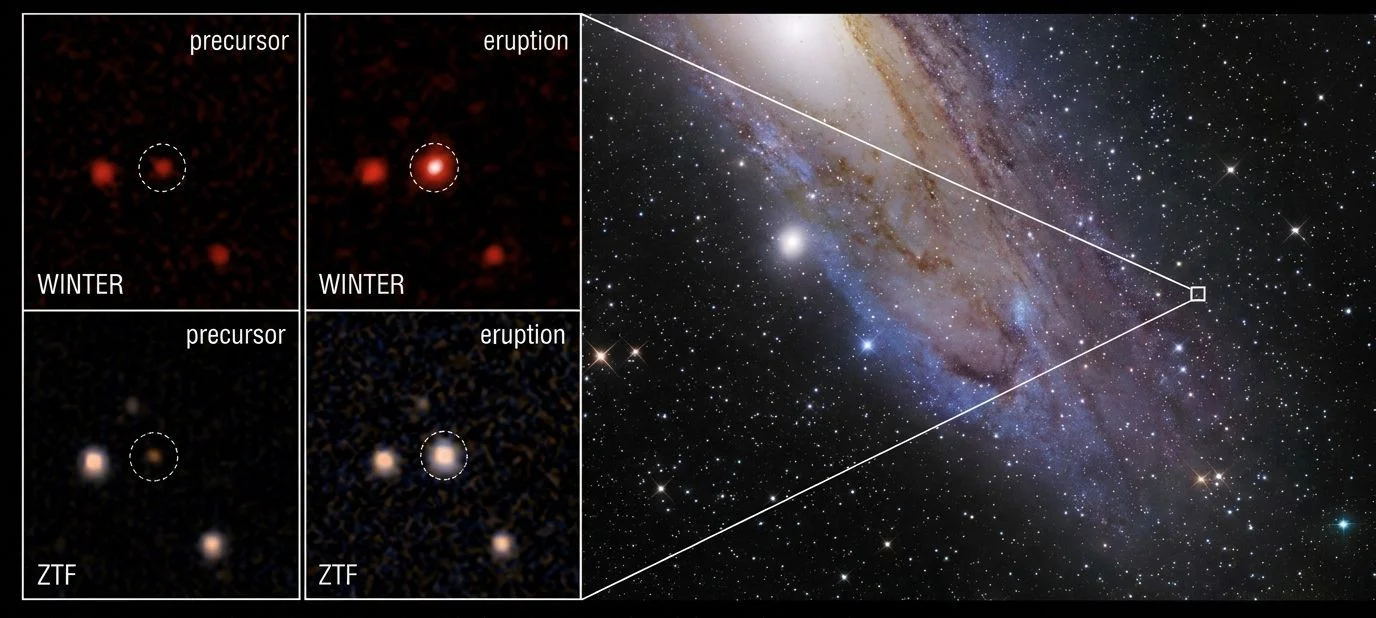
Dust and gas set the stage
SPHEREx observations in July 2025 revealed a key part of the lead-up: Big Bao was dimming in visible light while growing brighter in infrared. That pattern indicated the star was cooling and shedding dense clouds of gas and dust around itself. A star’s brightness in visible light alone can therefore give an incomplete picture; infrared observations helped the researchers track the material surrounding Big Bao as conditions changed.
When Little Bao reached Big Bao’s core, the impact flung stellar material outward at roughly 1.8 million miles per hour. The ejecta slammed into the surrounding gas and dust, producing the flash detected on Oct. 17, 2025. The sequence links the merger to the bright display: the collision sent material outward, and that material interacted with matter already around the system. The flare wasn’t simply the moment the smaller star disappeared; it also reflected what the collision hit on its way out.
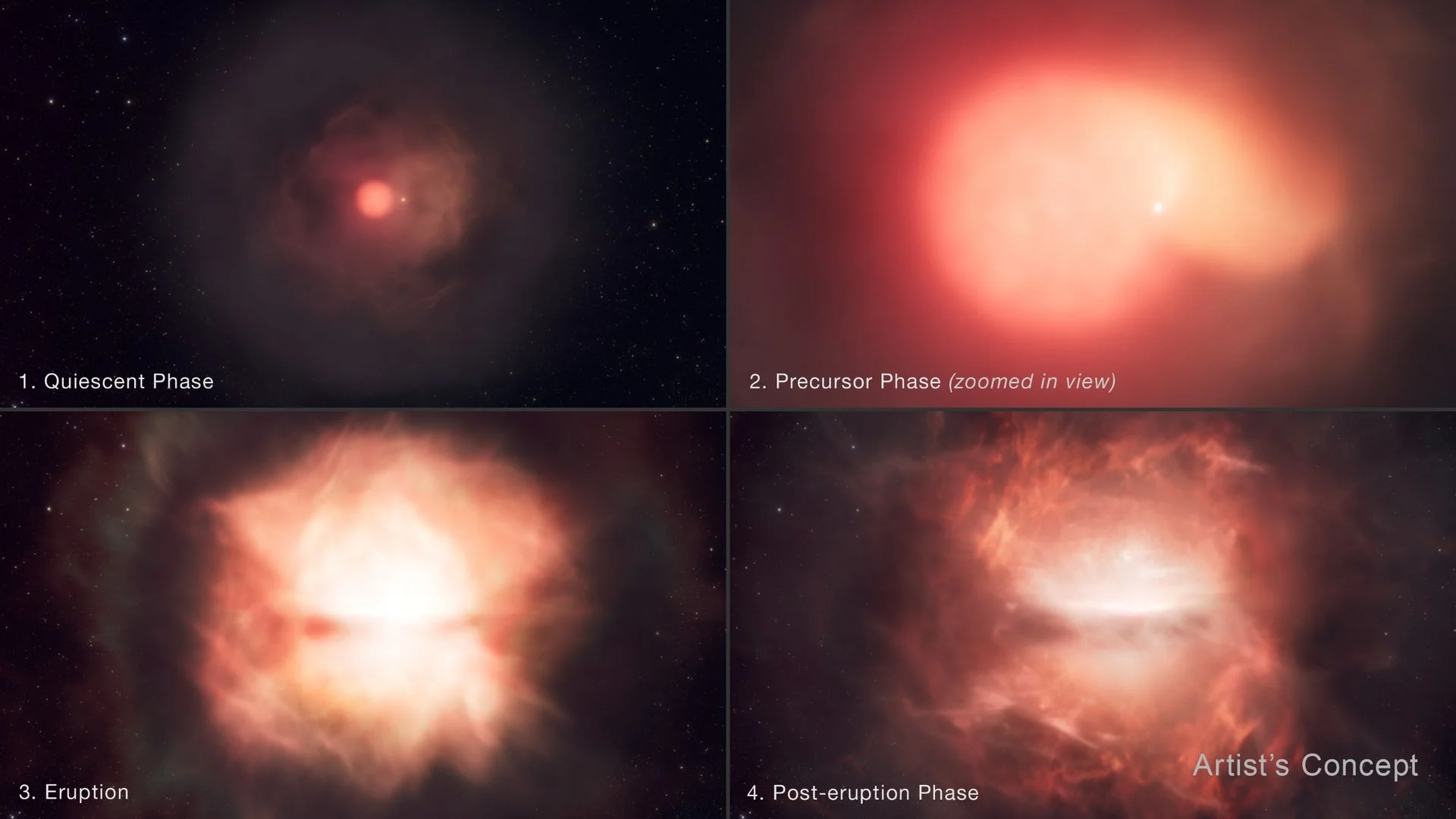
JWST observations on Dec. 24, 2025, measured the gas and dust surrounding Big Bao before the eruption, helping the researchers estimate Little Bao’s mass. Together, the data connect the star’s years-long brightening, its dusty surroundings, and the final collision in one account of the merger. The estimate also helps put the proposed sequence on firmer ground: the researchers could relate the companion’s inferred mass to the material around the giant, rather than relying on the flare alone.
What the observations make possible
Karambelkar described the observations as “the closure of just one chapter in a story that is just starting,” and pointed to what the coordinated effort showed about multi-observatory research. The team’s findings were published in Nature on Nov. 18. The result is a detailed account of one system, not a guarantee that astronomers can predict every future merger from a similar rise in brightness. Still, it gives researchers a set of observable stages to compare with other events.
If you're working in this space, the practical lesson is that time and wavelength both matter. Long monitoring can catch a system changing before an eruption draws attention, while infrared measurements can expose dust and gas that visible observations may miss. No single telescope supplied the whole story. A coordinated campaign did.
And yet, the evidence has limits: the merger itself wasn’t watched directly inside the star. The account is built from observations before and after the collision, interpreted through the team’s model. That’s a strong basis for tracing the event, but the distinction matters when extending the explanation to other systems. More cases will be needed to show how often this sequence applies.
The long lead-up. That may be the part that changes how astronomers read the next red nova: not just as a sudden flare, but as the final visible stage of a process that could have been underway for years.