Cassiopeia offers a simple way to watch Earth turn. Its five bright stars keep the same recognizable pattern, but over an evening the familiar W appears to tip into an E, an M or even a 3 as the constellation circles the northern sky. The stars aren’t changing their arrangement in any meaningful way over those few hours; it’s our changing viewpoint that makes the pattern seem to rotate.
That motion makes Cassiopeia more than a convenient marker. Watch it at two different times on the same night and the sky’s rotation becomes visible without a telescope, even from a light-polluted suburb. It’s a small observation with a useful payoff: Earth’s rotation becomes something you can see against the sky, rather than a fact you have to take on trust.
Watch the W turn
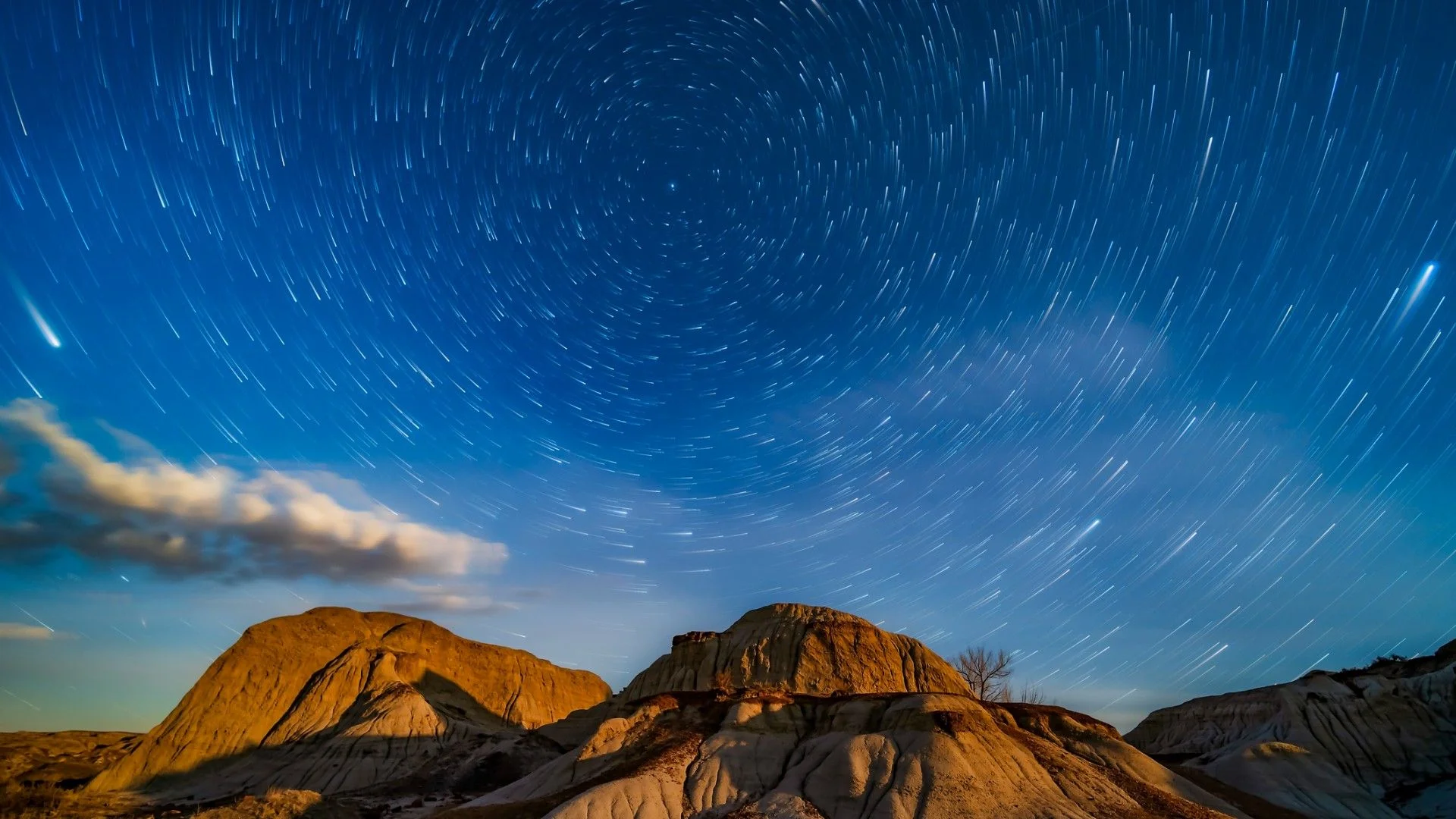
In late November, Cassiopeia is easy to find high in the northern sky during the evening. Look for five bright stars: Caph, Schedar, Navi, Ruchbah and Segin. Their apparent orientation depends on the time of night, so the same constellation can look quite different from one observation to the next.
Cassiopeia is circumpolar: at sufficiently northerly latitudes, it never sets. It circles the north celestial pole, near which Polaris currently sits. As Earth rotates from west to east, the constellation seems to move around that point, changing its angle against the horizon while the stars hold their pattern. Polaris can help orient you, but Cassiopeia makes the motion easier to notice because its angular shape is so distinctive.
For a quick observing exercise, note Cassiopeia’s position shortly after dark against a fixed landmark, such as a rooftop or tree. Check again a few hours later. The shift gives a direct view of Earth’s rotation, rather than an abstract explanation of it. Keep the reference point fixed and give your eyes a moment to adjust; the comparison is more persuasive than trying to judge the movement while looking continuously.
A familiar pattern at very different distances
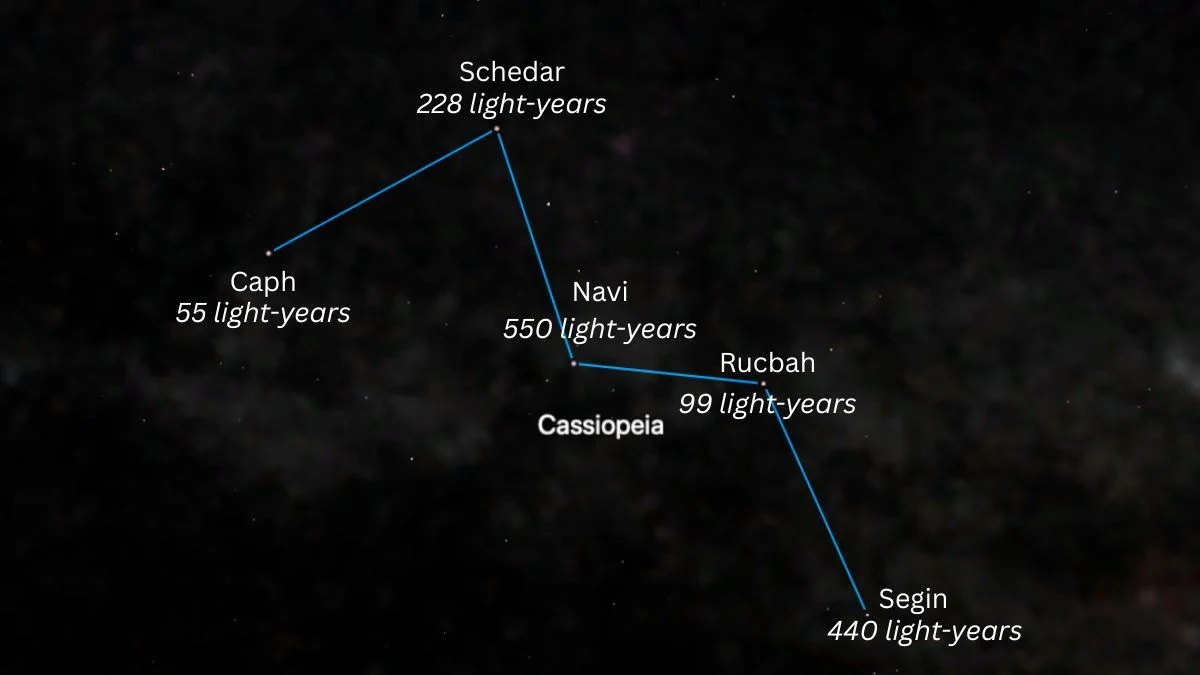
The five stars only look like a group from our viewpoint. Their distances from the Sun are:
- Caph: 55 light-years
- Schedar: 228 light-years
- Navi: 550 light-years
- Ruchbah: 99 light-years
- Segin: 440 light-years
Only Caph and Ruchbah are within 100 light-years. Cassiopeia is a useful shape in the sky, but its stars occupy very different stretches of space. The constellation’s outline is a line-of-sight effect: stars that appear near one another on the sky can sit at markedly different distances from Earth.
There’s a pleasing change of perspective at Proxima Centauri, 4.24 light-years from the Sun. Seen from there, our Sun would appear as an extra bright point in Cassiopeia. The constellation would have a sixth star—and Earth’s home system would become part of the pattern. That’s a reminder that familiar star figures depend on where you’re standing. The pattern is useful, but it isn’t a map of a compact neighborhood.
Binocular targets around Cassiopeia
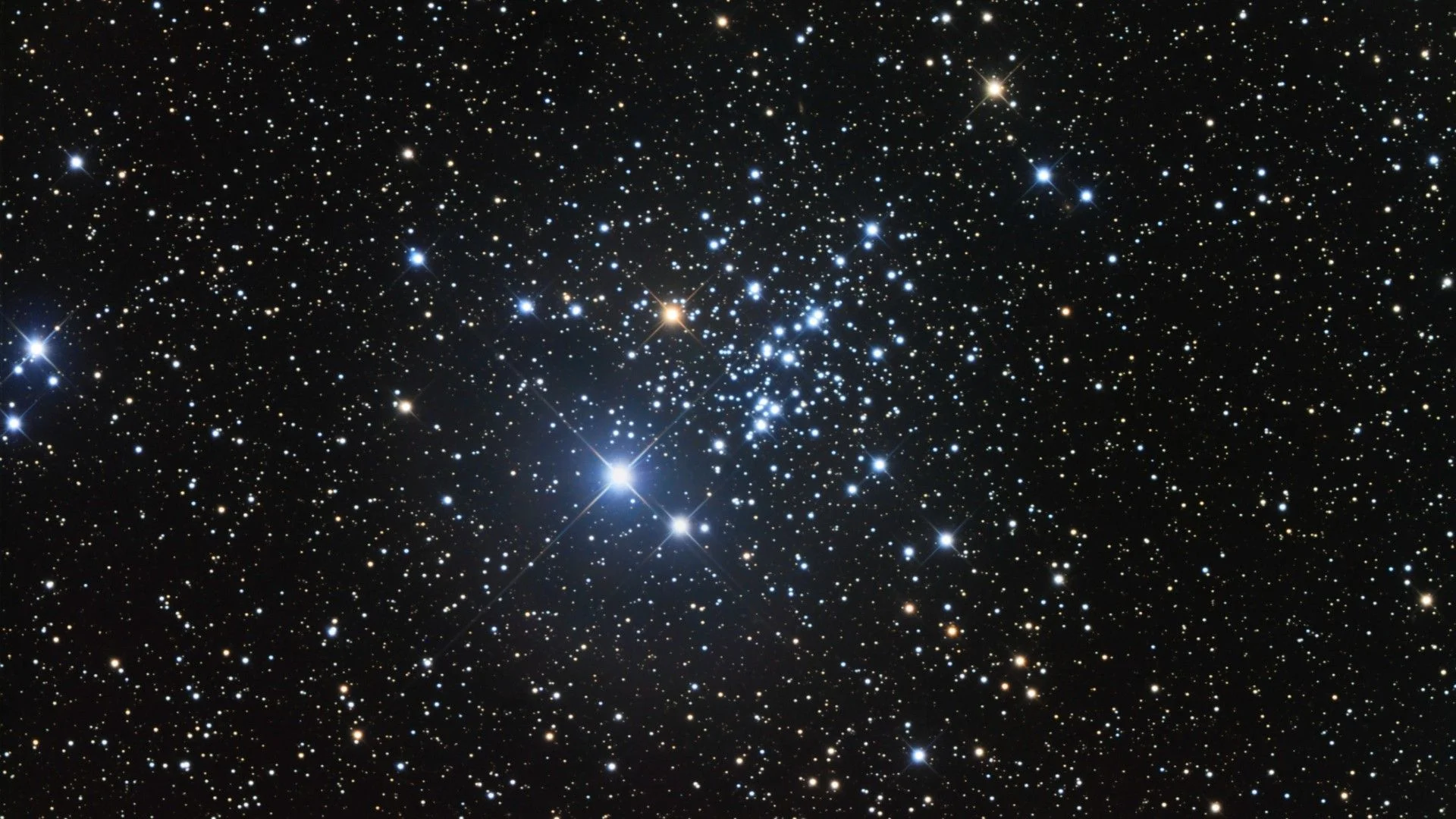
As the Moon wanes after its full phase earlier in the week, the final evenings of November offer darker early-night skies. It reaches last quarter on Dec. 1, rising around the middle of the night. That creates a useful window to scan the rich star fields between Cassiopeia and Perseus. The timing matters for observing: a bright Moon can wash out fainter stars, while darker hours make clusters easier to pick out.
The Double Cluster, NGC 869 and NGC 884, lies between the two constellations. Binoculars reveal two dense groups of young stars side by side against the Milky Way; under dark skies, the pair can also be seen with the naked eye. Cassiopeia holds several other worthwhile targets, including M52, NGC 457 (the Owl Cluster) and NGC 663. Binoculars are a practical starting point because they show more stars than the naked eye while keeping enough of the surrounding sky in view to help with orientation.
Before sunrise on Nov. 30
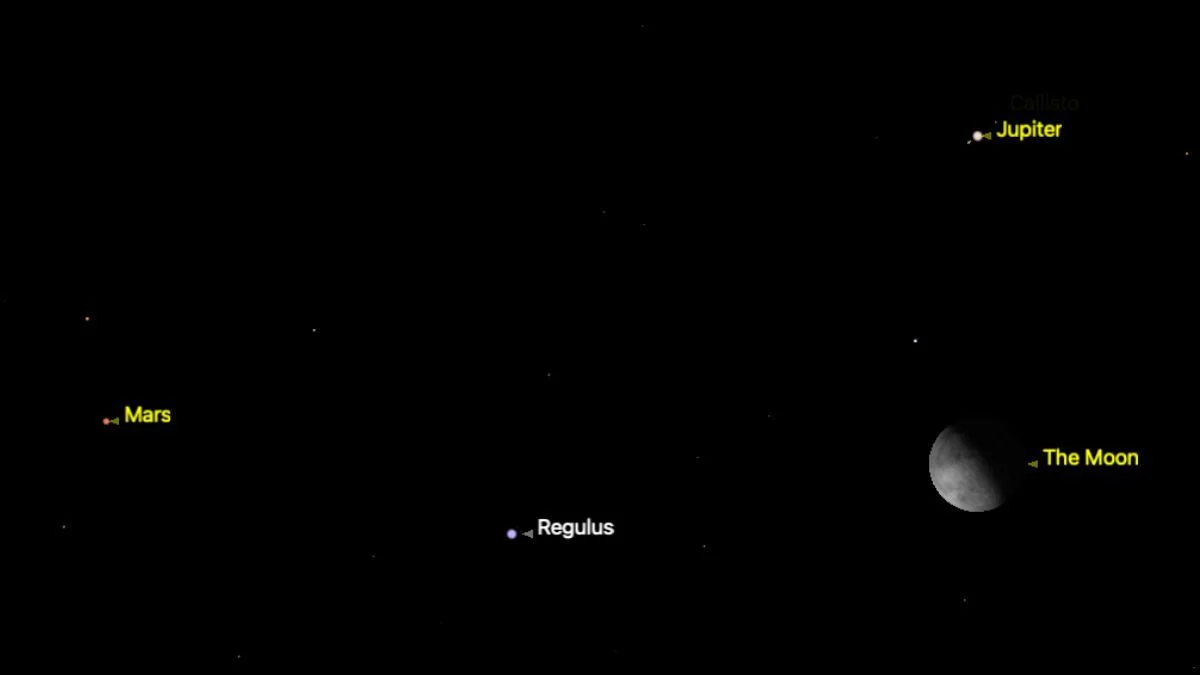
About 45 minutes before sunrise on Monday, Nov. 30, look high in the southern sky for the waning gibbous Moon alongside Jupiter, Mars and Regulus, Leo’s brightest star. The Moon will be 61% illuminated, and the four objects will form a crescent spanning just over five degrees—about three fingers held at arm’s length. That hand-width estimate is a simple way to picture the grouping’s apparent size without needing an app or measuring tool.
Jupiter will dominate the grouping, with reddish Mars and blue-white Regulus adding color. Binoculars can bring the scene closer, but the lineup needs no equipment. Here’s the thing: the spectacle depends less on magnification than on noticing how bright objects share one patch of sky. After watching the Moon and planets gather before dawn, Cassiopeia’s slow turn through the night offers a reminder that even a familiar sky keeps changing with our view of it.
Why the changing view matters
Cassiopeia makes two different ideas visible in one familiar shape: Earth’s rotation changes what we see over a night, while the constellation’s apparent outline gathers stars spread across space. This is more significant than it looks. A few minutes of looking can connect the daily movement of the sky with the much larger distances that make constellations visual patterns rather than physical groups.
If you're working in this space as an occasional sky watcher, use the W as a reference point, then return to the same view later and compare it with a fixed landmark. (And this is the part most people overlook: the changing angle is easier to see when you record where the pattern sits against the horizon.) A simple observing habit. The stars keep their arrangement; your place on a rotating Earth supplies the motion.