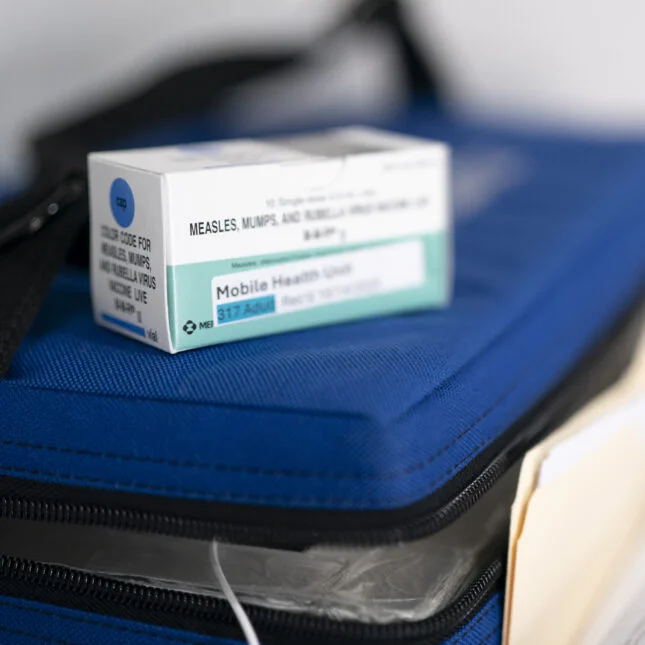
MAHA’s grassroots network could help reach parents who distrust public health institutions — and polling suggests many of those supporters already trust the MMR vaccine. That possibility deserves attention as the U.S. loses its measles elimination status, even if it means working with a movement whose loudest vaccine skeptics have helped deepen public mistrust.
On Tuesday, after the United States lost that status, Health Secretary Robert F. Kennedy Jr. said on X that he wanted to stop measles outbreaks, protect families, and restore elimination status. He also continued to recommend measles, mumps, and rubella vaccination as the most effective prevention.
There’s an opening in that message. Kennedy helped build MAHA, a movement that has shown it can organize millions of Americans around health concerns. The question is whether some of that organizing power can be directed toward measles prevention.
The public debate has settled into familiar camps. Medical societies have warned about the loss of elimination status, and politicians have criticized Kennedy and the Trump administration’s response. His defenders counter that other countries have also lost elimination status in recent years, and argue that attacks on Kennedy are political. Reconstructing how the country got here matters. But the more urgent question is who can persuade hesitant parents to vaccinate their children.
What listening has taught me
I believe in the measles vaccine. I had it as a child and vaccinated my two children. I generally trust my doctors, though I’ve sometimes wondered why the United States recommends more vaccines than some other countries. I haven’t had a major adverse reaction that would shake that trust.
For two years, my co-hosts and I have spoken with people who see vaccines, public health, and medical authority differently. Those conversations on “Why Should I Trust You?” have challenged my assumptions and helped me understand both why I trust institutions and where mistrust can take hold. Some guests are firmly opposed to vaccines; many others have accepted some shots while questioning others.
I’ve also watched MAHA supporters organize with striking speed. They’ve rallied around pesticides, pollution in air and water, microplastics, and PFAS, the so-called forever chemicals. At conferences, meetings, group chats, and Zoom calls, people trade ideas, work with lawmakers on legislation, and coordinate local campaigns. The question I hear repeatedly is simple: “What do you need? How can I help?”
That energy hasn’t vanished since the midterms. It’s looking for another outlet. MAHA-backed candidates suffered significant election defeats, and some supporters are angry at the Trump administration over what they see as broken promises on pesticides, corporate influence, and environmental health. Still, organizers have regrouped around issues such as the effects of data centers on communities, while continuing to challenge pollution and corporate power. Many don’t want to wait for government or medicine to solve problems for them.
Measles calls for a different kind of outreach. Health departments need to talk with parents who hesitate over childhood vaccines, including families who distrust government. Local agencies often lack the funding to find those families; even when they have resources, they may not have the relationships or cultural familiarity to earn their trust.
What if some of the people who could bridge that gap share those doubts? They may be skeptical of drug companies, admire Kennedy, or favor alternative medicine, yet still believe MMR is worth getting.
Many MAHA parents support measles vaccination
MAHA is a sizable political constituency, not a fringe group. KFF’s analysis of the 2026 midterms found that about three in 10 voters supported the movement, including 21% who strongly supported it.
And the survey data on parents complicates the assumption that MAHA support means rejecting MMR. In a KFF and Washington Post survey, 86% of MAHA-supporting parents said it was important for children in their communities to be vaccinated against measles. Nearly eight in 10 expressed confidence in MMR’s safety, and roughly three-quarters said their children were current on routine childhood shots, excluding Covid and flu.
That fits much of what I’ve seen. Most MAHA parents I’ve met have vaccinated their children against measles and polio, sometimes on a delayed schedule. I’ve met more who question Covid, flu, or the hepatitis B birth dose, and some who reject MMR. But the movement’s best-known vaccine skeptics can give a misleading picture of rank-and-file views. A person can care deeply about food, pesticides, water, and chronic disease, distrust some vaccines, and still have confidence in measles vaccination.
The evidence on MMR is clear: two doses are about 97% effective at preventing measles. Yet a correct statistic doesn’t automatically build trust. The person delivering it matters, especially when listeners have doubts that the speaker has never had to confront.
A messenger who changed her mind
Roberta Devers shows what that kind of persuasion might look like. A mother and midwife in Lancaster County, Pennsylvania, she spoke with my colleagues and me for an episode about the local measles outbreak.
Devers had been vaccine skeptical, supported Kennedy, and chose not to vaccinate her son as an infant. After seeing measles affect people in her community, she changed her view. She now believes MMR works and encourages Amish families in outbreak areas to get vaccinated. She says she receives one or two calls a week from families seeking vaccination. Her experience has also been shared in her account of the outbreak.
Her other convictions haven’t fallen away. Devers still admires Kennedy and doesn’t consider the medical establishment automatically trustworthy. She sees the outbreak as evidence of the distance between health systems and communities. She advocates for home-birth midwives to receive the same recognition as hospital-based midwives, and talks about holistic living, alternative medicine, whole foods, and using brown paper toilet paper because she wants to live close to the earth. As another account of her experience describes, what changed was her judgment about measles vaccination, not her entire worldview.
A hesitant parent may be more willing to hear from someone like Devers: a person who shares some of their suspicions but has watched measles up close and reached a different conclusion. She doesn’t need to defend pharmaceutical companies or claim the CDC is always right. Her story can start a conversation that a health official might struggle to open.
There are real limits here. Some influential MAHA figures have spent years questioning vaccines and spreading claims about MMR that aren’t grounded in science. Many will see any call to vaccinate, even during an outbreak, as a betrayal of their principles. And organizing a rally is not the same as carrying out a public health response.
Still, there’s a case for reaching the MAHA supporters who do trust MMR. The polling suggests they are numerous. Kennedy has said his department wants to close vaccination gaps and rebuild trust by working with trusted clinicians and community leaders. He could begin by elevating people such as Devers, then invite MMR-supporting MAHA members to organize local conversations, bring clinicians in to answer questions, listen seriously to families’ fears, and help connect parents with vaccines and peers who share their values.
That approach would draw objections. Kennedy would likely face backlash from the anti-vaccine wing of his coalition, and many MAHA supporters wouldn’t welcome the effort. But supporters have spent years insisting they aren’t anti-vaccine; they say they’re concerned about mandates, informed consent, conflicts of interest, and what they see as a refusal to address safety questions. They have pushed back against being labeled anti-vaccine.
Here’s a chance to show what that distinction means. Helping families make informed choices about a vaccine that most MAHA supporters trust needn’t violate their stated principles. It could put those principles into practice.
Public health officials have work to do, too. If people in MAHA are ready to help, officials should work with them while correcting misinformation and holding to the evidence. Shared ground is worth recognizing, even when trust is thin.
Some readers will call that naïve. Parts of MAHA have helped create the distrust that makes measles prevention harder. That’s true. But it doesn’t answer the practical question: might other supporters be unusually well placed to help solve a problem their movement helped make harder?
After an electoral setback, MAHA has a chance to show that its big tent includes more than political slogans. It could direct some of its organizing strength toward a disease affecting children and parents — the people the movement says it puts first.
Brinda Adhikari is a journalist and co-host of the “Why Should I Trust You?” podcast.