Voyager 1 is now one light-day from Earth, a distance no other spacecraft has reached. A command sent from the ground takes a full day to arrive, and the reply takes another day to come back. That's a striking number for a probe launched in 1977. The team gathered at NASA's Jet Propulsion Laboratory on Thursday (Nov. 19) to mark it, and the mood was celebratory. Underneath it sat a real problem: the spacecraft has not sent science or engineering data since Nov. 14.
The milestone itself came at 5:16 a.m. EST (1016 GMT) on Wednesday (Nov. 18). A light-day is the distance a photon covers in 24 hours, roughly 16 billion miles (26 billion kilometers). Voyager 1 is the most distant human-made object in space, and it now sits at the far edge of what a single day of light can span.
The event at JPL's Von Karman auditorium was the first public Voyager gathering since 1989, when Voyager 2 flew past Neptune. That gap says a lot about how long these probes have been running on a shoestring of attention, if not on a shoestring of power.
An anomaly the team expects to fix
The celebration didn't pretend the problem away. JPL spokesperson Raquel Villanueva said Voyager 1 stopped transmitting science and engineering data on Saturday (Nov. 14). The team has stayed in contact with the spacecraft while it works the issue, and it's confident the fix will come.
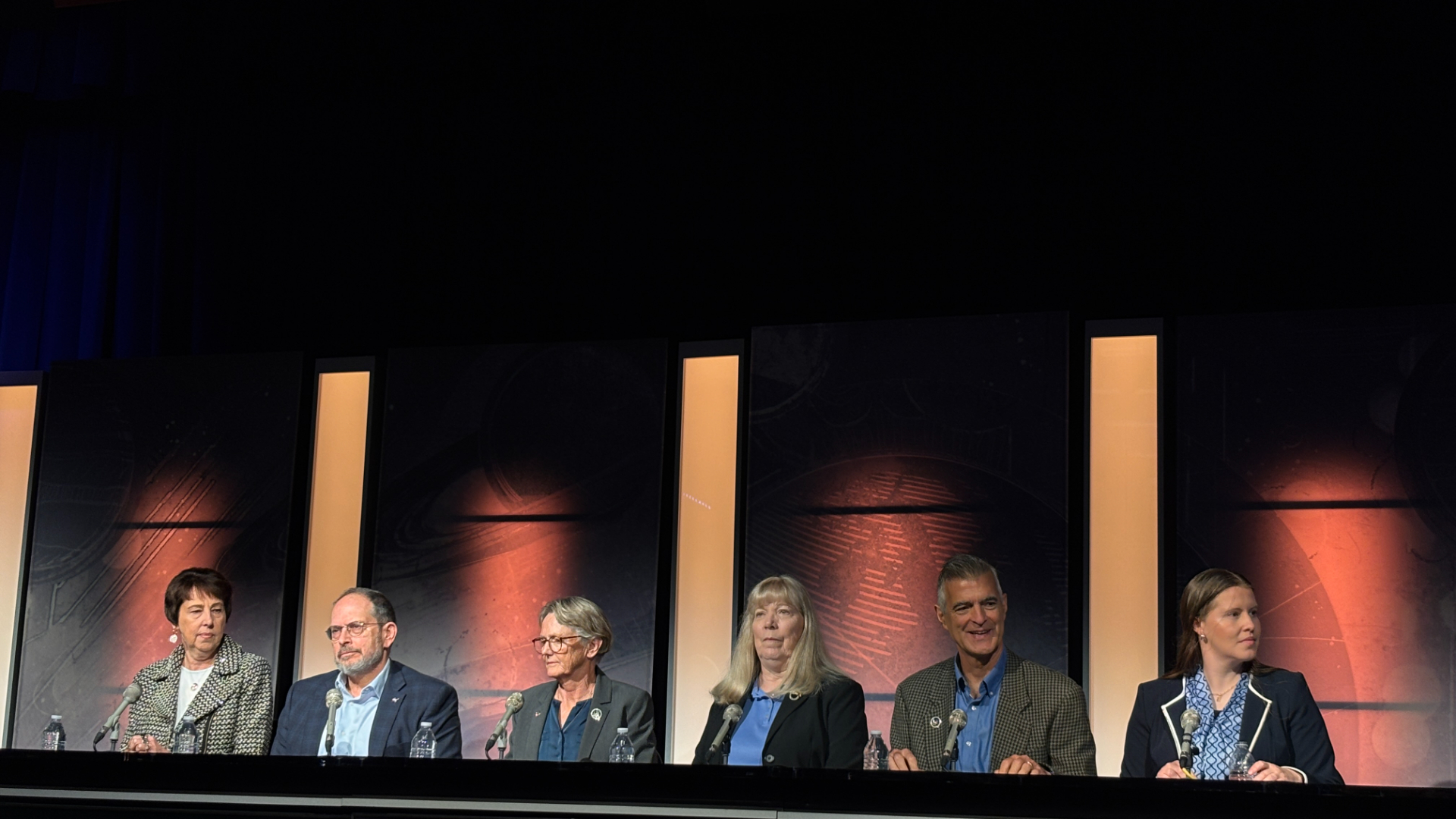
Voyager project manager Suzanne Dodd described the situation in plain terms. "We listen to each spacecraft every day," she said. "We have an anomaly that is not something unseen before. We do have a very strong carrier signal. We currently don't have a frame sync, so we're not getting the science or engineering data currently."
The distance is the real obstacle. "One light-day is very far from us," Dodd said. "It takes 24 hours to get the signal to the spacecraft, 24 hours for the signal to come down, so it takes two days to diagnose anything on the spacecraft. So we can't do anything fast, and the data rates are very low."
Dodd doesn't read the glitch as a warning sign for the mission's long-term health. She framed it as the kind of wear that comes with age. "These spacecraft are old," she said. "All of us old people have our aches and pains, and sometimes it takes longer to stretch out your muscles and remember things, and so we are in a realm where we're going to see more anomalies with Voyager just due to the distance and the age."
The team's confidence rests partly on the fact that the probe is still doing its basic job. "Although it's not sending us the telemetry data, it's pointed at the Earth," Dodd said. "It's sending us a strong carrier signal, and I'm confident that it won't be too long, and it will send us data back."
Voyager 2, the slower twin, is in better shape at the moment. Dodd said it is doing very well on its journey through interstellar space. "Voyager 2 is very healthy. It's continuing its mission. It has three scientific instruments on it," she said. She added that both probes are "setting a record every day for longevity or distance."
A celebration with real feeling
Most of the team had been up all night confirming the one-light-day signal, and the room still felt charged. The Voyagers have been flying for nearly 50 years on a mission that was expected to last five, so the team had earned a party.
Between the technical updates, the event screened footage of Voyager celebrations from around the world. Children cheered for the probe, and landmarks lit up gold in honor of the mission's Golden Record. That footage moved Nicky Fox, NASA's associate administrator for the Science Mission Directorate, close to tears.
"I actually thought I was going to start sobbing," Fox said after the briefing. "I think just hearing children's voices and people saying 'We love you, Voyager,' 'Go Voyager' — it just was amazing."
The message wasn't limited to people on the ground. NASA astronaut Jessica Watkins recorded a video from the International Space Station and addressed the probe directly. "As an orbiting outpost just 250 miles [400 kilometers] above Earth, we often feel distant yet deeply connected to our home planet," she said. "While you have been traveling into the unknown for nearly half a century, helping pave our path, together, our two journeys tell a single story of exploration."
Watkins closed with a line that captured the event's tone. "Voyager 1, you have been a beacon of light, a symbol of exploration, a seeker of truth, a carrier of hope, a brave explorer, traveling further than any human hand has ever reached," she said. She finished with a weightless backflip aboard the station.
The briefing ended with a round of applause for everyone who has worked on the mission over five decades, and some have been involved longer than that. Team members today range from their 20s to their 90s, so the mission's workforce spans several generations.
A golden moment
Fox's celebration started earlier in the week. On Tuesday evening (Nov. 17), she and writer and producer Ann Druyan switched on the Empire State Building lights in gold. Druyan was the wife of the late astronomer Carl Sagan, whose work helped shape the mission's Golden Record, and she later helped bring the famous "pale blue dot" image of Earth to the public.
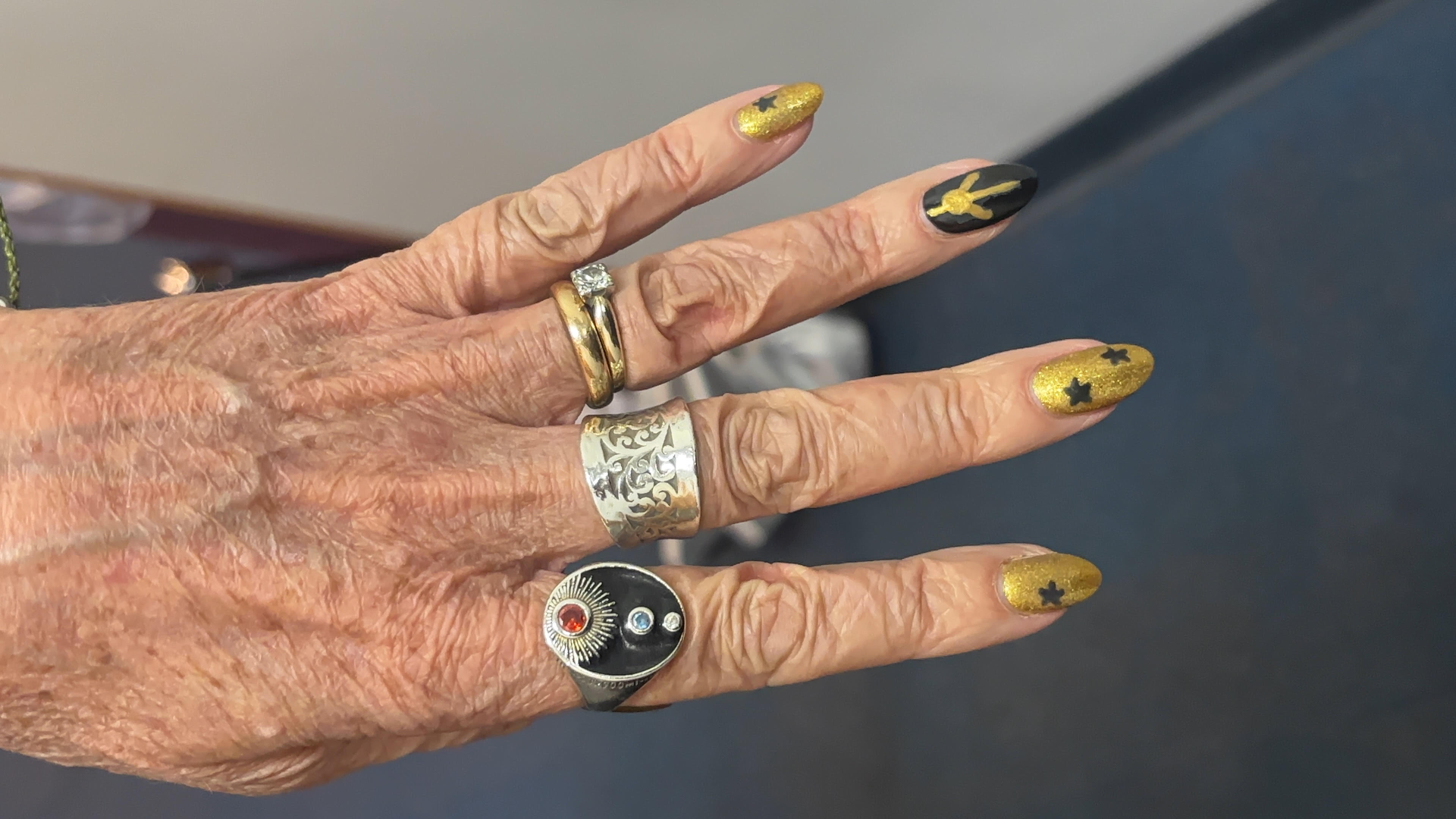
"I was actually very privileged to flick the switch and turn on the Empire State Building lights on Tuesday evening," Fox said, wearing golden Voyager-inspired nail polish her daughter had made. "That was just spectacular. I was there with Ann, we were both so giddy with the excitement of doing it. It was amazing. And then going up and standing underneath and seeing the tower was just really, really special."
Looking to the future
The team's attention has already moved past the milestone. Voyager turns 50 in 2027, and it remains an active science mission. The probes are now in a part of space no spacecraft has explored before, and that's the real draw.
"Voyager right now, the two Voyagers, they're in an area of space that we've never been into," Fox said. "So every single bit of data that comes back is precious because it's unique."
Voyager deputy project scientist Jamie Rankin pointed to the science that new data could unlock. "Now we're in a region where the sun's influence is a lot different, and we're in this region where we can start to understand: What is it like out past our sun? What is it like in the space between the stars?" she said. "We're at a very exciting time of starting to connect what we know and what we've seen, living with this star to what is out there."
Fox was blunt about the endgame, or the lack of one. "What's next? Voyager is just going to keep on going," she said. "It's never going to end. Even when we can no longer talk to Voyager, they're both going to keep going. So there's no end for the Voyager mission."