An independent team has reproduced the Event Horizon Telescope's image of a supermassive black hole, and the match is close enough to matter. The result strengthens confidence in the EHT's picture and, by extension, in the general relativity framework that predicted what that picture should show.
The EHT image, released in 2019, shows the black hole at the core of the galaxy Messier 87 (M87), about 55 million light-years away. The object, designated M87*, carries roughly 6.5 billion times the mass of the sun. Imaging something that distant and that massive is a brutal technical problem. Samuel Lai, who leads the team at Australia's Commonwealth Scientific and Industrial Research Organisation (CSIRO), put it bluntly: "It is like standing in your backyard and trying to take a photo of a doughnut on the moon."
Why the image needed a second look
The EHT is not a single dish. It's a global network of telescopes working as an interferometer, effectively creating an Earth-sized instrument. That approach brings two headaches. The first is the atmosphere, which distorts the signal. The second is the reconstruction step, where raw telescope data gets turned into a picture, and where processing choices can quietly shape what emerges.
Lai's group took a different path. They built machine learning and artificial intelligence tools to pull out the black hole's structure and filter out interference from observing through Earth's atmosphere. Their technique, called GenDIReCT, also accounts for biases introduced when telescopes are combined into one virtual instrument.
Here's the part that makes the test meaningful. When the team ran the method on the original EHT dataset, it produced a black hole almost identical in size and shape to the historic image. Crucially, the model had no prior picture of what a black hole should look like. "Our model had no idea what a black hole looked like when we applied it to the M87 data," Lai said. "This is the first truly independent validation of the EHT image, an important step in the scientific process."
That independence is the point. If a method that doesn't carry the EHT team's assumptions arrives at the same ring, the chance that the image is an artifact of processing drops considerably.
What general relativity predicted
Albert Einstein published general relativity in 1915, and it changed how physicists think about gravity. The theory describes mass curving the fabric of space and time, which it treats as a single entity called spacetime. Gravity, in this picture, is what that curvature feels like.
Push that logic to its limit and you get black holes. Karl Schwarzschild found a solution to Einstein's equations describing a region of extreme mass packed into an incredibly small volume, creating a singularity where curvature becomes unrestrained. Around it sits a boundary, the Schwarzschild radius, inside which not even light can escape. That boundary is now called the event horizon.
Black holes were, in a sense, born on paper in 1915. They took decades to find observationally and more than a century before the EHT captured one.
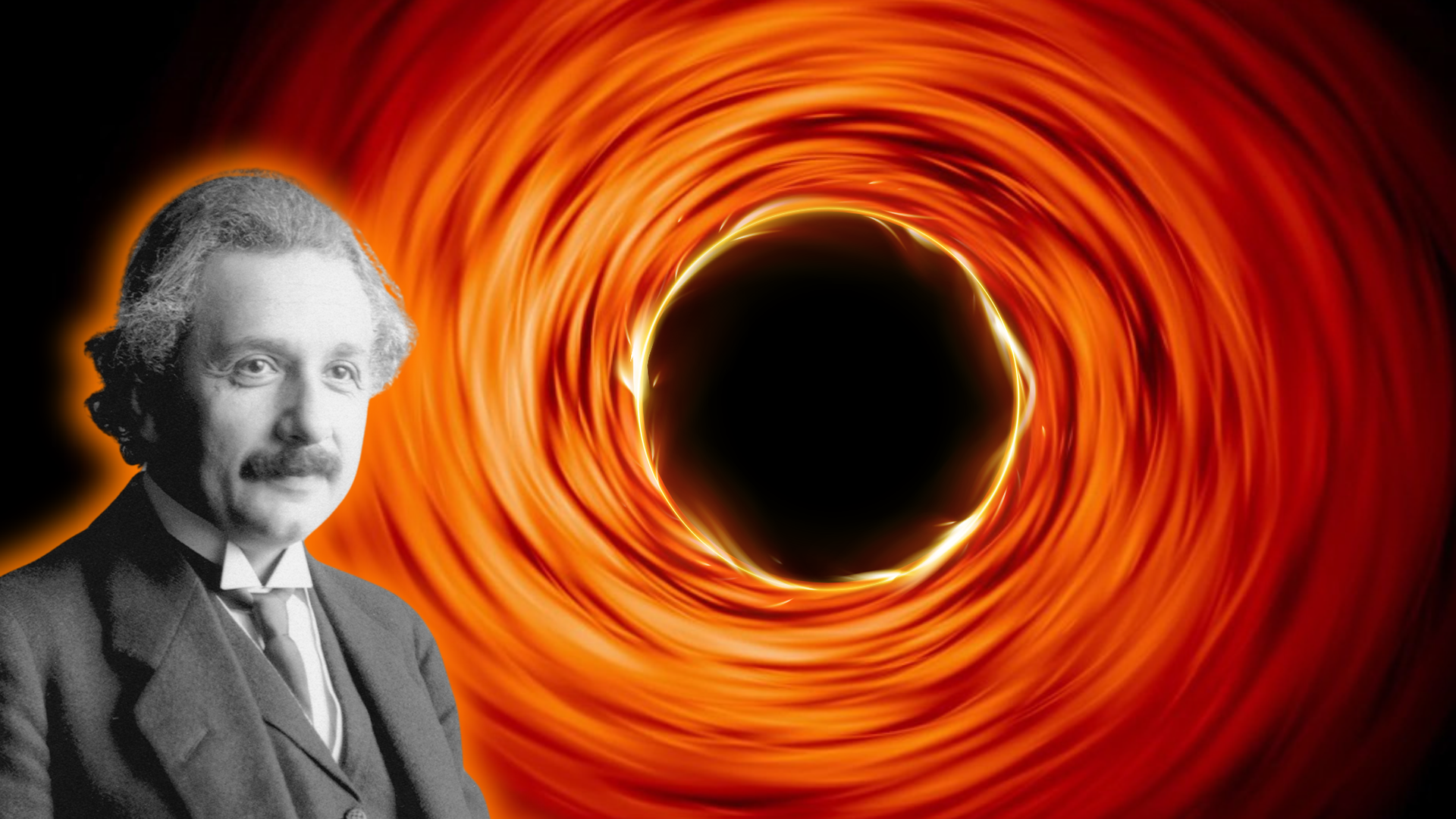
The theory also predicted what the region around the event horizon should look like: a ring of superheated, glowing plasma, with the black hole's shadow sitting at its center. When the EHT image appeared, researchers were struck by how closely it matched that prediction. The new validation adds another layer of support to a result that already looked right.
Beyond black holes
The CSIRO team sees potential beyond astrophysics. Lai's group has suggested the technique could eventually help with more earthbound problems, such as improving medical imaging and mapping earthquakes.
Laurent Loinard, Director of the EHT Collaboration, framed the result in terms of trust in the process. "Independent validation is at the heart of the scientific process, and it is especially valuable for results as novel as those of the EHT," he said. He called it "extremely gratifying" that GenDIReCT, "an elegant, entirely independent method," recovers the ring structure of M87* across several years, in excellent agreement with the collaboration's published results.
Loinard added that studies like this "strengthen our confidence in what we have learned about black holes, and enrich the toolkit available to the whole community."
The findings were published Wednesday (Nov. 11) in Nature. The bigger question now is whether other teams with their own methods reach the same ring. If they do, the EHT image stops being a single team's achievement and becomes something the field can build on with much more confidence.