Comet 220P/McNaught erupted twice in a matter of weeks, briefly turning a faint object into a much brighter target for amateur observers. The outbursts also offer researchers a closer look at how the crusts of short-period comets respond to solar heating.
On May 31, 220P was at magnitude +17.39, far too faint for most amateur equipment. In less than 14 hours, it brightened to magnitude +11.05. By June 2, it had reached magnitude +8.23, making it briefly detectable through 10x50 binoculars from a dark location.
The first eruption began June 14 as the comet approached perihelion, its closest point to the sun. At that point, 220P was still 1.5 astronomical units from the sun, or about one and a half times Earth’s average distance from it. The comet later faded to magnitude +12, then flared again: from magnitude +14 on July 28 to +6.1 on August 6.
Dust driven from the comet’s crust
The likely trigger is familiar to comet researchers. Solar warmth causes buried ices—including water, carbon dioxide and nitrogen—to turn directly into gas. As gas escapes through the dusty crust, pressure can break away sections of the surface and send dust into the surrounding coma, the cloud of material around the solid nucleus.
Models of 220P’s eruption suggest it released dust weighing anywhere from tens of billions to hundreds of billions of pounds. The grains, each only a few millionths of a meter across, spread outward at about 390 meters per second, scattering sunlight and making the comet appear dramatically brighter.
“We have concluded that the comet detached localized parts of its crust, creating a dust-rich envelope that increased [the comet’s brightness by] 250 times in half a day,” said Josep M. Trigo-Rodríguez of the Institut de Ciències de l’Espace and the Institute of Space Studies of Catalonia in Spain. The findings were published November 3 in Monthly Notices of the Royal Astronomical Society.
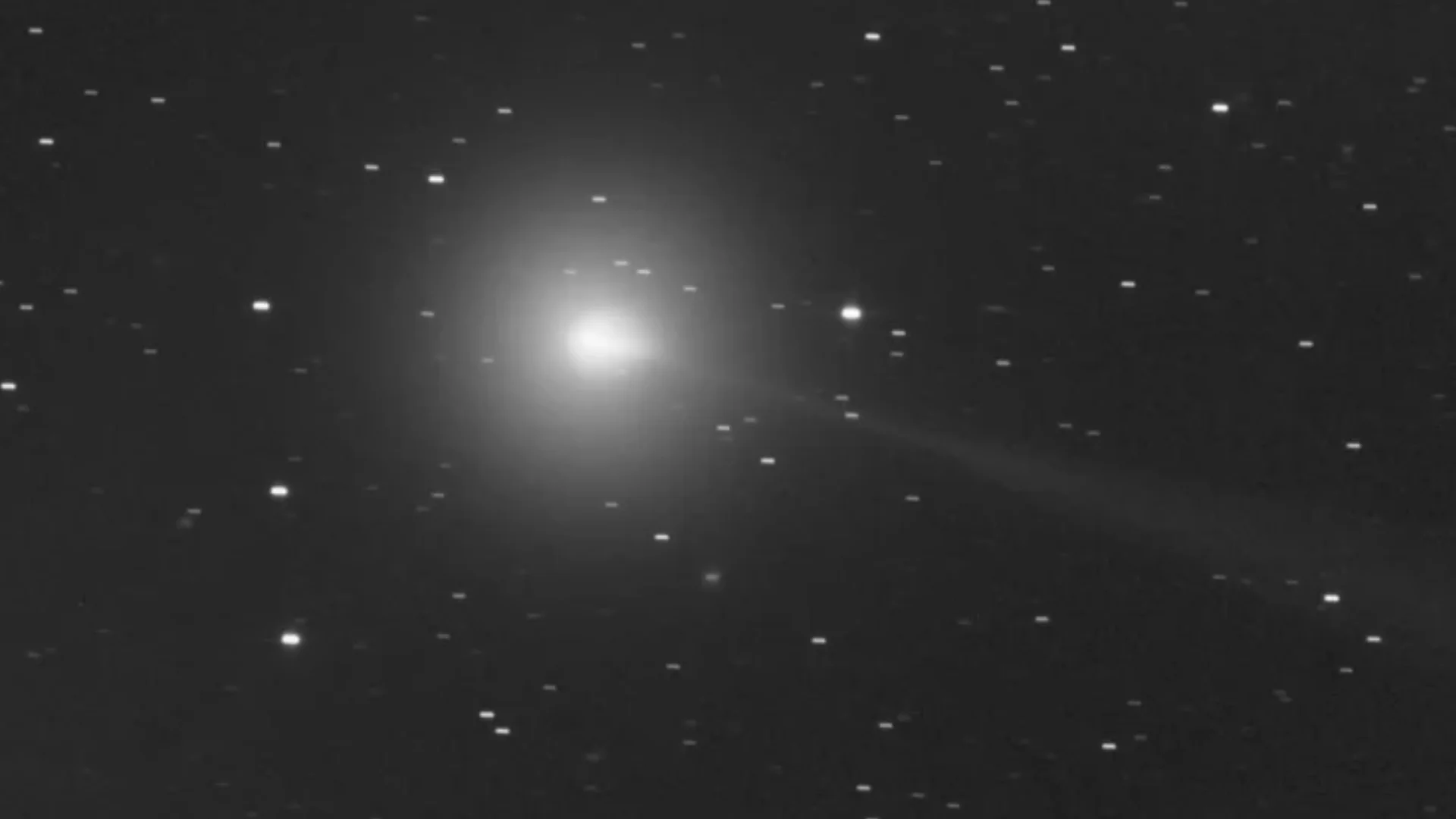
A rare flare from a Jupiter-family comet
Discovered by Australian astronomer Robert McNaught in 2004, 220P returns to the inner solar system roughly every five and a half years. Its orbit brings it as close to the sun as Mars before carrying it outward to a point just inside Jupiter’s orbit. In ordinary conditions, the comet is dimmer than magnitude +15.
That makes this year’s eruptions a notable departure from its usual behavior. Another striking comet outburst came from 17P/Holmes in 2007: its brightness rose from magnitude +17 to +2.8, a million-fold increase, and it became visible to the naked eye in Perseus.
220P belongs to the Jupiter-family comets, a group thought to originate mainly in the Kuiper Belt and Scattered Disk before migrating inward into short-period orbits under Jupiter’s influence. “Jupiter-family comets are extremely interesting objects to study because they originate primarily from the Kuiper Belt and the Scattered Disk region, later migrating inward until Jupiter captures them into short-period orbits,” Trigo-Rodríguez said.
Outbursts can reveal properties of these distant-origin bodies, including how strongly their material holds together. Trigo-Rodríguez said his team is interested in comet tensile strength and structure in the context of impact hazards. Some comets may be fragile enough that responding to a potential collision threat would require different disruption methods from those considered for asteroids.
220P passed its closest point to Earth on October 12, at about 1.04 astronomical units, or 156 million kilometers, away. It is now moving back toward the outer solar system, fading at magnitude +13. Its farthest point from the sun will lie 4.68 astronomical units away, about 700 million kilometers. The next return in late 2031 will give astronomers another chance to see whether this normally subdued comet erupts again.