A milestone measured in signal delay
Voyager 1’s one-light-day milestone will put a hard limit on how quickly Earth can communicate with a spacecraft: by the time the probe reaches the mark, a radio signal will need about 24 hours to travel in either direction. That means a command sent from Earth won’t arrive until a day later, and a response from the probe will take another day to get back. For mission controllers, every exchange already demands careful planning across vast distances; at this range, even a simple question and answer becomes a multiday process.
Distance measured by light travel
NASA expects Voyager 1 to reach one light-day from Earth on Nov. 18, 2026, at 5:16:07 a.m. EST (1016:07 GMT). A light-day describes the distance light travels in 24 hours. At roughly 186,000 miles (300,000 kilometers) per second, that works out to about 16 billion miles (26 billion kilometers), according to NASA. The milestone is defined by the time a signal needs to cross the gap, not by a special boundary the spacecraft will pass through or a change in its surroundings.
The term can sound like a measure of time, but a light-day is a unit of distance, like a light-year. These units help make interplanetary and interstellar distances easier to compare than miles or kilometers alone. They also put communication in familiar terms: the same distance that light crosses in a day sets the minimum travel time for a radio signal making a one-way trip, since radio waves travel at the speed of light.
The scale is striking beside familiar trips. Sunlight takes about eight minutes and 20 seconds to reach Earth, placing our planet roughly 8.3 light-minutes from the Sun. Depending on where the planets are in their orbits, a radio signal between Earth and Mars takes three to 22 minutes. Voyager 1’s one-way delay will be much longer, making the everyday intuition that a spacecraft can be contacted and quickly corrected a poor guide to how deep-space operations work.
Operations at a one-day delay
At one light-day, a message from Voyager 1 will take a full day to reach Earth; a command sent back will take another day to arrive. Engineers must factor that two-way delay into spacecraft operations, fault diagnosis and assessments of how the probe responds to commands. They can’t rely on rapid back-and-forth exchanges to clarify what happened or adjust a sequence as it unfolds. Planning has to account for the possibility that the spacecraft’s next status update will arrive only after a long wait.
Voyager 1 has been traveling away from Earth since its launch on Sept. 5, 1977. Now in interstellar space and moving at nearly 38,000 mph (61,000 kph), it has spent more than 49 years covering the distance light crosses in one day. Even at that speed, it is moving far more slowly than light. The comparison explains why the probe’s journey can span decades while its signals still take an increasingly long time to catch up with Earth’s expectations.
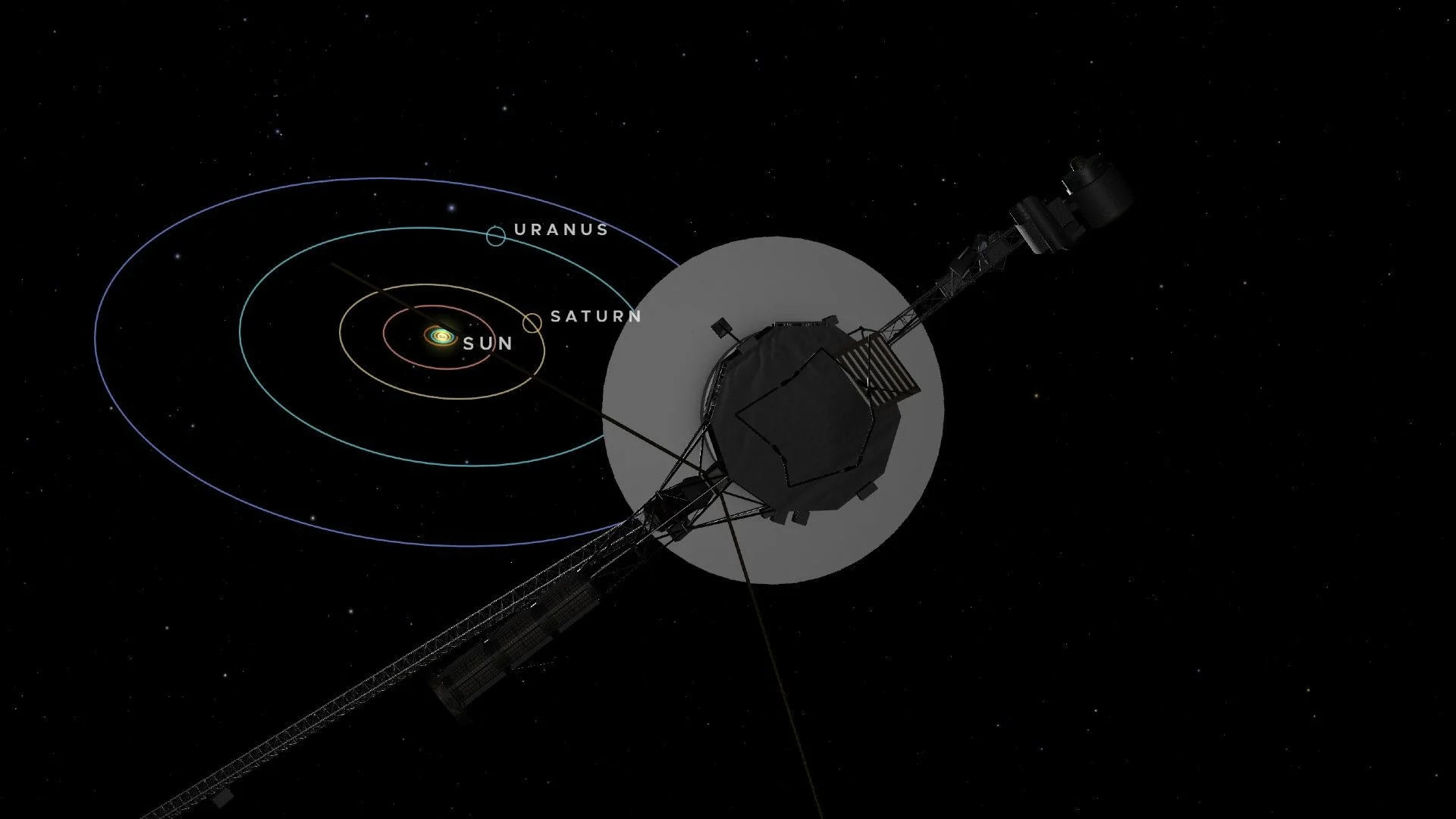
That delay has already shaped efforts to keep the probe operating. A recent communications glitch underscored the difficulty of diagnosing and addressing problems when signals take so long to cross the distance between spacecraft and Earth. A team has to work from information that may describe a situation from many hours earlier, then allow additional time for any attempted response to arrive. That’s a demanding way to troubleshoot. And this is the part most people overlook: distance doesn’t just slow the conversation; it changes what kinds of decisions can be made in real time.
What the milestone means for deep-space work
This is more significant than it looks. The one-light-day mark gives a clean way to describe a practical constraint that often remains abstract: the farther a spacecraft travels, the less its operators can treat it like a machine waiting on the other end of a phone line. A signal can carry instructions and information, but it can’t erase the time required to cross the gap. Controllers must build that delay into how they plan, interpret updates and respond to trouble.
If you’re working in this space, the lesson is that communication time is part of the mission’s operating conditions, not just a technical detail. At long range, spacecraft autonomy and careful sequencing matter because controllers can’t observe every action as it happens or intervene immediately. Voyager 1’s milestone doesn’t mark a sudden change in the probe’s capabilities. It makes the existing constraint easier to grasp: an exchange with Earth will take days to complete.
Voyager 2, launched in 1977 on a different trajectory, is expected to reach one light-day from Earth in November 2035. As both probes continue through interstellar space, their journeys make the operational cost of distance increasingly tangible: sending a command is only the start of a conversation that can take days. The probes’ continued travel will keep stretching that interval, leaving mission teams to work with slower feedback and to plan around the time signals need to travel. That’s the shape of the challenge.