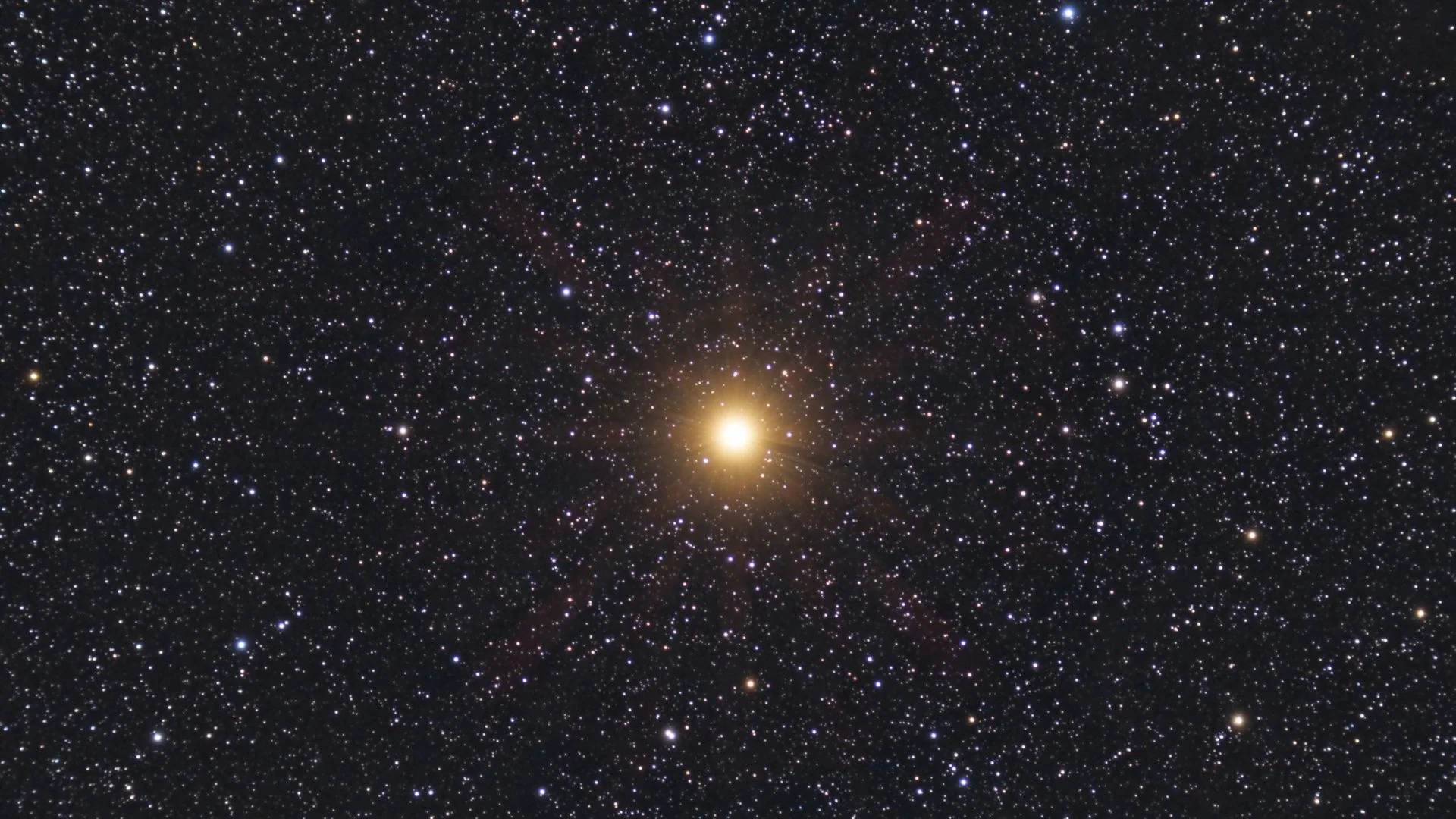
Betelgeuse’s latest fade is a reminder that a star’s brightness can change for several reasons at once. The red supergiant in Orion has slipped from magnitude +0.5 to +0.95 since August, leaving it slightly fainter than the orange star Aldebaran. That shift fits Betelgeuse’s history of variation, but it doesn’t identify a single cause. Its regular pulsation, recurring long dimming cycle, and occasional eruptions of dust all shape what we see from Earth.
Recent observations have also strengthened the case for a faint companion, formally called Alpha Ori B and nicknamed Siwarha. Its orbit may help explain a dimming pattern that has puzzled astronomers for decades. The evidence offers a more layered account of the star’s behavior: different brightness changes can have different drivers, and some events may combine several of them.
Three timescales behind the changing light
Betelgeuse has a familiar rhythm: roughly every 430 days, it expands and contracts. As it swells, its outer layers cool and the star dims. As it shrinks, those layers heat up and the star brightens. The effect is pronounced enough to make Betelgeuse the only strongly variable star among the first-magnitude stars, the brightest category visible in the night sky.
There’s also a much slower fluctuation, lasting about 2,100 days, or 5.75 years. Astronomers call this a Long Secondary Period. For roughly a century, its origin remained uncertain. Some proposed an orbiting star; others found no convincing evidence for one. Images and observations published in January 2026, using the European Southern Observatory’s Very Large Telescope and NASA’s Hubble Space Telescope, provided the clearest direct evidence yet for a faint companion.
The third timescale is less regular: large-scale ejections of material can produce dramatic, temporary changes. These episodes matter because gas cast into space can cool and form dust that blocks some of the star’s light. Betelgeuse’s brightness record is therefore not one smooth cycle. It is the visible result of overlapping stellar processes.
What Siwarha may explain
The companion appears to orbit deep within Betelgeuse’s outer chromosphere, a layer of the star’s atmosphere, completing a circuit about every six years. As it moves through gas and dust shed by the supergiant, its gravity may gather material into a dense wake. That wake can create ripples and shockwaves, disturbing the stellar wind and the flow of mass away from the star.
If a concentrated trail of dust crosses the line of sight between Earth and Betelgeuse, the star can look dimmer. This offers a possible explanation for the longer cycle, though it doesn’t mean every dip comes from the companion. The researchers’ observations establish a compelling candidate and mechanism; the recent shift in brightness, by itself, can’t confirm that Siwarha caused it.
The companion’s name carries a small piece of the story. Betelgeuse’s own name has a disputed origin. It was long interpreted as a corruption of Arabic words meaning “The Armpit of the Giant.” Some experts instead favor “The Hand of al-Jauzā,” with al-Jauzā referring to Orion. Astrophysicist Jared Goldberg reportedly proposed “Betelbuddy” for the companion, but Siwarha—Arabic for “her bracelet”—was ultimately chosen, echoing the alternative interpretation of Betelgeuse’s name.
A familiar comparison in the evening sky
Betelgeuse is about 650 light-years from Earth and ranks among the largest and most luminous stars of its kind. At its brightest, it radiates about 14,000 times the Sun’s luminosity; at its faintest, about 7,600 times. Those figures describe an enormous star, even when its changing appearance makes it seem less imposing.
Its apparent brightness is measured in magnitudes, where smaller numbers indicate brighter objects. Betelgeuse reached magnitude 0.0 in April 2023, matching Vega’s apparent brightness. At low points such as those recorded in 1927 and 1941, it has reached about +1.2 and looked roughly three times fainter. British astronomer Sir John Herschel first recorded its variability in 1836.
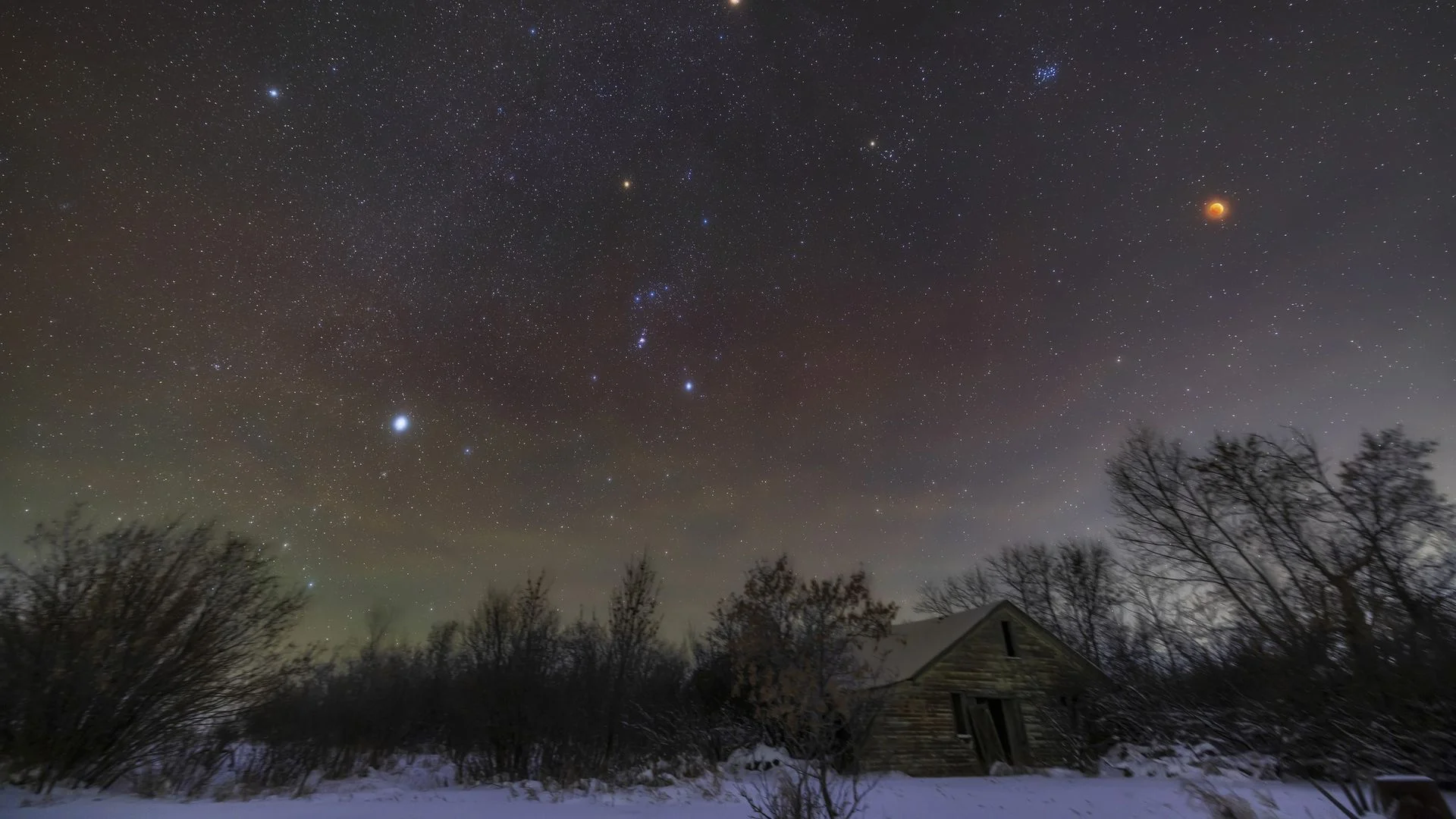
For a simple sky comparison, look toward Aldebaran in Taurus. It has recently appeared a little brighter than Betelgeuse. Aldebaran rises in the east-northeast before 7 p.m. local standard time, with Betelgeuse following about 90 minutes later. By 11:30 p.m., both should be visible in the east-southeast.
To find Aldebaran, start with Orion’s three bright belt stars and extend an imaginary line through them upward and to the right. After about two fists’ width at arm’s length—roughly 22 degrees—you’ll reach the V-shaped Hyades cluster, which outlines Taurus’s face. Aldebaran glows at one end of the V. The two stars make a useful visual comparison, though atmospheric conditions and each star’s ongoing variation can affect what the eye perceives.
The 2019–2020 Great Dimming
The sharpest recent example of Betelgeuse’s variability came between October 2019 and February 2020. During that episode, known as the Great Dimming, the star lost more than two-thirds of its apparent brightness, falling from magnitude +0.5 to +1.7. It later recovered, reaching an unusually bright magnitude 0.0 in spring 2023.
The sudden drop prompted speculation that Betelgeuse might be nearing a supernova. But infrared observations and models found no significant change in its intrinsic luminosity. The star remained in its helium-burning phase, with an estimated 100,000 years or possibly many hundreds of thousands of years before its eventual explosion.
The leading explanation for the Great Dimming came from combining data collected by Hubble and ground-based observatories. A huge bubble of hot plasma rose from a convective region inside the star and erupted into space. Far from Betelgeuse, the ejected material cooled quickly and condensed into solid silicon monoxide dust. From Earth’s viewpoint, that cloud acted like a screen, obscuring a substantial share of the star’s light.
Timing amplified the effect. The eruption coincided with the low point of Betelgeuse’s 430-day pulsation cycle, while the companion’s gravitational influence may also have contributed. The episode shows why a single mechanism can be an incomplete explanation: an ejection, a dim phase in the regular cycle, and possible orbital effects can overlap.
What the latest fade tells us
Betelgeuse’s orange-gold appearance and unruly changes have made it a standout for generations of observers. Henry M. Neely, a longtime Hayden Planetarium lecturer, captured the star’s restless nature in A Primer for Stargazers, describing how it “expands and contracts spasmodically, like an old man with his strength almost entirely spent, panting in the asthmatic decrepitude of old age.” The imagery is vivid; the modern account is more precise, pointing to pulsation, mass loss, dust, and a probable companion.
The latest dip is best read as another observation to compare against those processes, rather than as proof of one specific cause. Continued monitoring can show whether its timing and depth align with the long cycle, a dust event, or the star’s ordinary pulse. For skywatchers, the practical takeaway is simple: compare Betelgeuse with Aldebaran over time. For astronomers, each new measurement helps separate the overlapping rhythms of Orion’s giant star.
Joe Rao serves as an instructor and guest lecturer at New York's Hayden Planetarium. He writes about astronomy for Natural History magazine, Sky and Telescope, The Old Farmer's Almanac and other publications.