The early universe may have supplied a shortcut to building massive black holes: in tightly packed star clusters, repeated stellar mergers could produce enormous stars that later collapsed into black hole seeds. The same turbulent clusters may also account for the James Webb Space Telescope’s puzzling Little Red Dots.
That connection comes from simulations of young cosmic environments, where frequent stellar encounters could lead to very different outcomes. Fast impacts would destroy the stars involved. Slower encounters, however, could let stars merge repeatedly, building a single star with far more mass than a typical star. When it died, that giant could collapse into a black hole larger than one formed from an ordinary massive star.
“Perhaps the strangest outcome of our simulations is that stars can merge repeatedly within the cluster until they form one gigantic star with a mass equal to that of an entire cluster,” said Claire Williams, a member of the research team at the University of California, Los Angeles (UCLA). “When a star this huge reaches the end of its life, models suggest that it may have no option but to collapse into itself and form a massive black hole.” Williams said in a statement.
Conditions in present-day galactic centers don’t appear to support the same process. Although stars are densely packed there, existing supermassive black holes accelerate nearby stars through their gravitational pull. Collisions in those regions would tend to be too violent to build oversized stars through gradual mergers.
A head start for the first supermassive black holes
The JWST has found supermassive black holes in the universe’s first billion years, raising a timing problem for astronomers. Black holes are thought to grow through feeding and mergers, processes that would ordinarily take at least a billion years to produce objects weighing millions or billions of times as much as the sun.
One proposed answer is that these black holes didn’t begin as small remnants of individual stars. They may have started as intermediate-mass black holes, which sit between stellar-mass black holes and the supermassive objects found at the centers of galaxies.
A massive star’s collapse typically produces a stellar-mass black hole weighing about 10 to 100 times the sun’s mass. Intermediate-mass black holes are estimated to weigh 100 to 100,000 solar masses. A single star shouldn’t be able to create one under familiar conditions, but the crowded, merger-rich environments in the simulations could change that limit.
“Dense star clusters provide a natural birthplace for massive black-hole seeds in our model,” Williams said. “The same environment that forms the black hole can also provide stars and gas that influence its subsequent growth.”
What the black hole theory could mean for Little Red Dots
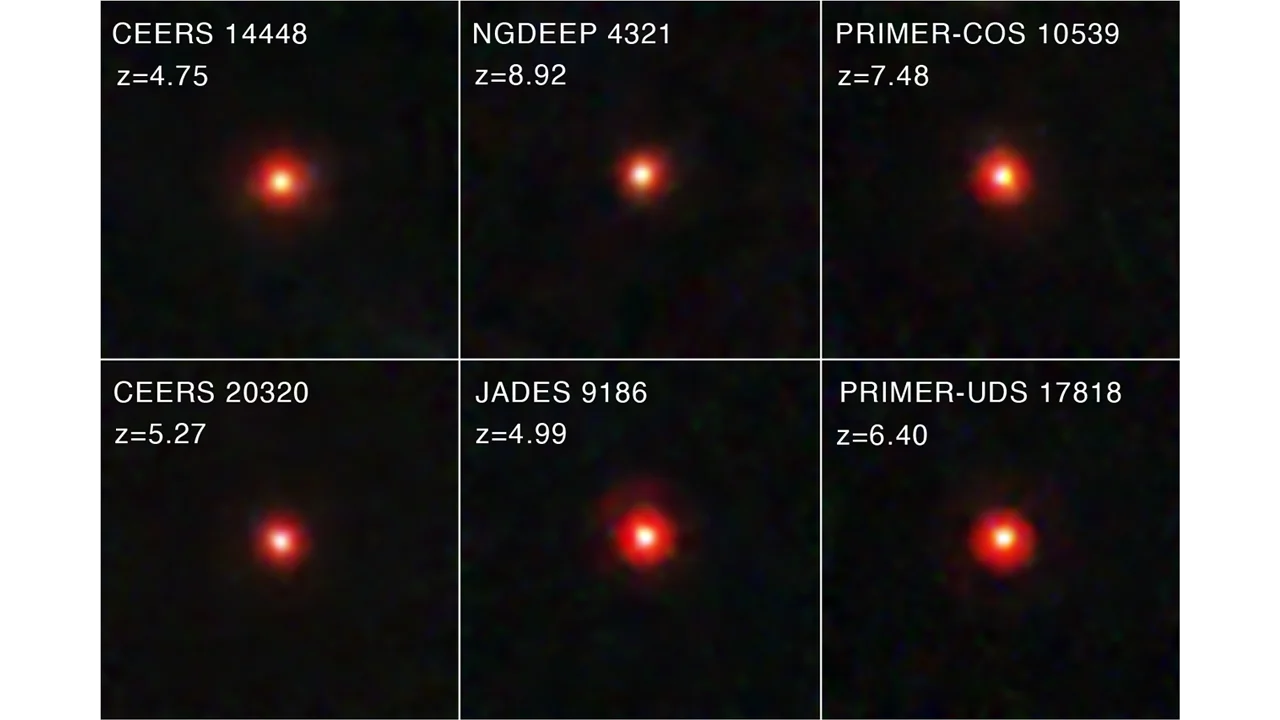
Those clusters could also help explain the JWST’s Little Red Dots, compact objects seen in the early universe that appear to be absent by the time the cosmos was two billion years old. Their nature remains unsettled. One explanation holds that they contain rapidly growing black holes.
“Little Red Dots are a hot topic in astronomy. You can compare studies of people trying to understand Little Red Dots to the tale of blind people who are trying to describe an elephant by touching it, and each person describes it differently based on what part they’re touching,” said Smadar Naoz, a UCLA researcher and member of the team. “Our research connects several of those perspectives together and may help us see more of the elephant.”
In the team’s simulations, a Little Red Dot could be a dense star cluster undergoing repeated collisions. The mergers would build an oversized star, which could then collapse into an intermediate-mass black hole. That scenario links the objects’ compact appearance with a possible route to the larger black hole seeds seen at early times.
The timing of the objects’ disappearance may fit that picture. Less than a billion years after the Big Bang, the universe was dominated by dense, chaotic regions of star formation rather than well-ordered spiral galaxies. As the universe expanded and cooled, those regions became the building blocks of more settled galaxies. If Little Red Dots depend on unusually crowded clusters, that transition could have removed the conditions that sustained them.
The simulations offer a shared explanation for two early-universe puzzles, but observations will need to establish whether Little Red Dots really are collision-heavy star clusters and whether those clusters can form the proposed black hole seeds. The research was published Oct. 26 in the Astrophysical Journal.