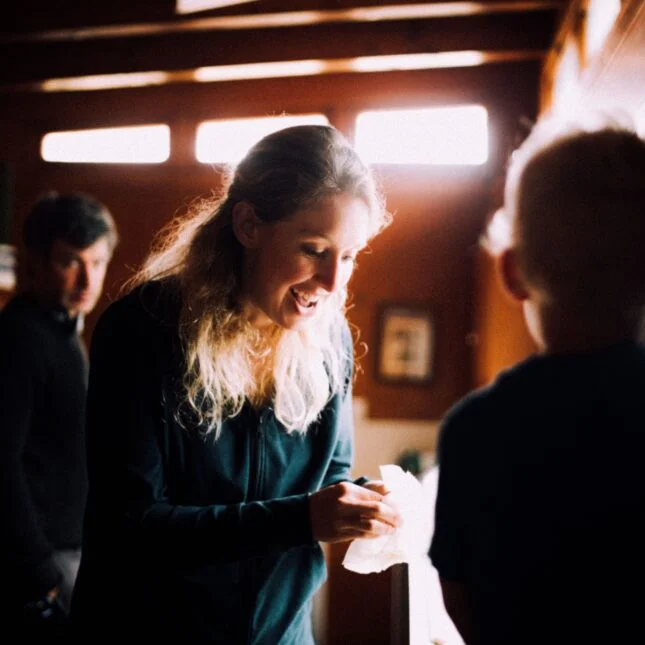
This essay contains spoilers for “You Can See Everything,” Nathan Fielder’s film about Theranos founder Elizabeth Holmes.
“You Can See Everything” is sharp, funny and artfully uncomfortable. Its most consequential choice, though, is what it leaves outside the frame. The film follows Elizabeth Holmes in the period before she reported to prison, but its close attention to her domestic life can make disputed claims about Theranos feel like a matter of interpretation. That ambiguity has an artistic purpose. It also risks blurring the facts behind the fraud.
I know Holmes from more than a film. I worked at Theranos and became a whistleblower; she also sat on the board with my grandfather and came to family gatherings. I met her at 20. She went to prison when I was 32. When journalist John Carreyrou began looking into the company, I urged him not to underestimate her. The film left me with the same concern about how readily an audience might accept the story Holmes presents.
The device at the center of the dispute
Fielder lets Holmes revisit a Theranos machine in pieces, arranging its components on a kitchen table. She describes a platform that could perform a wide range of tests once the necessary chemistries had been developed. The conversation then narrows to the word “could”: what Holmes meant, what listeners understood, and whether she grasped the difference.
At one point, Fielder uses the comedy routine “Who’s on First?” to test whether Holmes takes language so literally that she cannot follow the joke. In Shultz’s reading, her apparent confusion encourages viewers to imagine a person whose unusual way of thinking explains the gap between her statements and other people’s understanding. He sees that performance as strategic rather than innocent.
The hardware on that table matters more than the semantic debate. Shultz says it was not the instrument he used during his long workdays at Theranos, the one the company concealed from regulators, or the one involved in patient testing and failed quality controls. Holmes showed Fielder a later design that was never completed or used. That let the discussion turn on a hypothetical product instead of the device responsible for the company’s results.
The instrument Theranos actually used was called the Edison. Shultz describes it as an eight-channel pipette inside a black box, using blood-testing chemistry and detection methods that had been around since the 1970s. It handled one test at a time and was limited to immunoassays, rather than the broad range of tests Holmes had publicly suggested. It also could not carry out the initial dilution accurately on its own: staff first had to put the nanotainer into a large Tecan pipetting robot. The Edison lacked microfluidics, a centrifuge and automated sample preparation.
That ordinary, limited machine would have changed the scene’s meaning. Viewers could have seen what the company’s patient testing actually depended on, rather than a proposed future system. Shultz wonders whether Fielder didn’t know the difference or chose not to challenge Holmes because the film needed uncertainty. Either explanation points to the same editorial tradeoff: the ambiguity works better as cinema when the Edison stays out of sight.
Domestic scenes and the image of restraint
The film’s setting also invites questions. Holmes and her husband, Billy, appear in a modest, dimly lit rented condo in San Diego. Shultz notes that Billy’s family owns a five-diamond AAA resort at Torrey Pines, while Holmes had lived in an estate listed for $125 million before the cameras arrived. A small rented home can suggest a pared-back life; without context, that impression may not tell viewers much about her circumstances.
Shultz sees a parallel with a 2014 profile by Ken Auletta in The New Yorker. Auletta described Holmes as living in a two-bedroom Palo Alto condo, eating most meals at the office and giving up novels, friends and dating. Shultz says that account omitted her home life with Theranos executive Sunny Balwani in an Atherton mansion. Balwani, who had a volatile relationship with Holmes, was later sentenced to nearly 13 years in prison for his role in the fraud.
For Shultz, the choice to film Holmes in a humble-looking condo recalls an earlier version of her public image: a disciplined founder living simply while building a company. He questions why Fielder didn’t ask about the move from the Green Gables Estate, whose published photographs show a very different scale of living. The contrast doesn’t establish what the film intended, but it does make the missing context relevant.
Another visual choice concerns Holmes’ trip to begin her sentence. In a recent interview, Billy said the couple flew from San Diego to Texas on a private jet. The film shows them leaving by Cybertruck. Shultz imagines a scene on the jet that might have prompted questions about the pilots and their connection to the couple. The point is less the vehicle itself than the way carefully selected details can shape a viewer’s impression.
Abuse and responsibility can coexist
The film also asks whether Holmes was abused by Balwani. Shultz believes she was, and says that fact doesn’t excuse her conduct. He has long thought Holmes could both experience abuse and take advantage of Balwani’s abusive behavior. Those ideas are difficult to hold together, but the film’s strongest scene gives him a metaphor for doing so: Fielder compares the dynamic to David Blaine pushing an ice pick through his own hand. It isn’t a trick; the injury is real, and Blaine still knows what he is doing.
Shultz reads the relationship shown on screen as real enough to evoke sympathy from Fielder, actress Amanda Seyfried and the audience. Seyfried, who played Holmes in Hulu’s “The Dropout,” also appears in the film. Yet Shultz argues that Holmes could be a victim in the relationship while remaining conscious of how others would read specific moments. He points to a scene in which Billy takes over whisking eggs, suggesting Holmes knew the gesture would serve as a compact portrait of their dynamic.
Shultz also challenges the idea that Holmes’ actions arose from a sincere belief in Theranos’ claims. He says he doesn’t think she began the company intending either to defraud investors or to help patients. His interpretation is that she wanted fame: the status of the youngest self-made female billionaire, magazine covers and comparison with Steve Jobs. He says her conduct showed little empathy for patients harmed by inaccurate results.
He has also long believed Holmes positioned Balwani to absorb blame. When Shultz emailed her with concerns about the company’s failures, he says, she forwarded his message to Balwani, who responded. Shultz says his grandfather continued serving on the board after a year of Wall Street Journal reporting and federal investigations partly because the board believed Balwani was responsible after he was fired.
Financial records complicate the question of belief
At trial, Holmes again blamed Balwani. Shultz observes that he was convicted on all 12 counts against him, while Holmes was convicted on four. The outcomes don’t settle every question about their relationship or their individual roles, but they add context to the film’s presentation of Holmes as a possible victim.
The question of whether Holmes believed her own claims also looks different when set against the company’s financial disclosures. The Securities and Exchange Commission said Holmes presented a potential investor with Theranos’ 2014 financial results showing $108 million in net revenue. The company’s actual revenue that year was little more than $100,000, according to the agency. Shultz adds that Holmes declined to provide investors with audited statements. To him, that mismatch is difficult to reconcile with a founder who simply misunderstood what the company had achieved.
Fielder may be signaling that he, too, is a compromised presence in the film, and that he may have left out facts that would have complicated Holmes’ account. Shultz can’t tell whether the result makes Fielder a poor documentarian or a skilled filmmaker pursuing a different kind of story. That uncertainty is part of the work’s design—and its limit. To assess Holmes’ claims, viewers need the evidence the film largely keeps beyond its walls: the Edison, the company’s records and the history behind the image Holmes chooses to present.
Tyler Shultz is a scientist at heart, founder by nature, whistleblower by accident, speaker by day, venture partner by night, and a dad 24/7.